Understanding Time in Indian History: Chronology, Periodization, and Calendar Systems
History is not just a collection of random stories about kings, wars, and ancient empires; it is a systematic study of change over time. When we look at the “History of Bharat”—a civilization that spans over five thousand years—the sheer volume of events, people, and cultural shifts can easily feel overwhelming to a beginner. To make sense of this vast ocean of the past, historians use specific tools to organize, measure, and map out time. Without these tools, historical events would be a confusing, jumbled puzzle, making it impossible to understand how one event naturally led to another.
This article explores the three foundational pillars of historical timekeeping: Chronology, Periodization, and Calendar Systems. We will begin by examining chronology, the science of arranging events in their exact sequence using the BCE and CE timeline. Next, we will dive into periodization, the method of dividing thousands of years of continuous history into manageable “chapters,” such as Ancient, Medieval, and Modern. Along the way, we will also explore why historians debate these specific labels today. Finally, we will look at the fascinating calendar systems of India, tracing how ancient societies used the sun and moon to measure time, leading up to the creation of the modern Indian National Calendar.
For any student preparing for exams or a general reader stepping into the past, mastering these concepts is the crucial first step. Before we can ask “what” happened or “why” it happened, we must clearly understand “when” it happened. Grasping how historical time is structured provides the essential framework you need to confidently and accurately explore the rich, complex heritage of India.
What is Chronology in History?
To understand the vast and complex story of India—or any civilization—we must first understand how to organize it. This is where chronology comes in. The word “chronology” comes from two ancient Greek words: chronos, meaning “time,” and logos, meaning “the study of.” Put simply, chronology is the science of arranging historical events in the exact order in which they occurred.
Imagine history as a giant jigsaw puzzle. The individual puzzle pieces are the events, people, and discoveries of the past. Chronology is the framework or the border of the puzzle that helps us see where each piece fits. Without it, historical events are just a confusing, jumbled collection of stories with no clear beginning, middle, or end.
Why is Chronology Important?
Chronology is the backbone of history. Historians rely on it not just to know when something happened, but more importantly, to understand why and how it happened.
When we place events in a strict chronological order, we can identify cause and effect. In history, an event that happens earlier often directly influences an event that happens later.
For example, in the history of ancient Bharat, we first study the decline of the Indus Valley Civilization, followed by the arrival of the Vedic culture, and later, the rise of the Magadha Empire. By understanding this exact sequence, a student can clearly see how shifts in geography, agriculture, and society during the Vedic age created the foundation for the powerful political empires that emerged later. If we mixed up this order, the logical progression of human development would completely disappear.
The Tools of Chronology: BCE and CE
To arrange events accurately, historians need a universal scale to measure time. Today, the most widely used system globally, including in modern historical writing about India, divides time into two broad periods.
When reading history books, you will frequently encounter two key abbreviations:
- BCE (Before Common Era): This refers to all the years before the start of the current global calendar. In older books, this is often written as BC (Before Christ).
- CE (Common Era): This refers to all the years from year 1 onward. We are currently living in the Common Era. In older texts, this is written as AD (Anno Domini, a Latin phrase meaning “in the year of the Lord”).
How to Read Timeline Dates
The most important rule for beginners to remember is how the counting works.
- In the CE (Common Era), we count time forward. The year 200 CE comes after 100 CE.
- However, in the BCE (Before Common Era), we count time backward. The year 500 BCE is older than the year 300 BCE.
Think of BCE as negative numbers on a math timeline; the larger the number, the further back in time the event occurred. For instance, the mature phase of the Harappan Civilization began around 2600 BCE and ended around 1900 BCE. We count down towards the year 1.
How Historians Build a Chronological Record
You might wonder how historians figure out the exact order of events that happened thousands of years ago. They act like detectives, piecing together a timeline using two main types of evidence:
1. Archaeological Evidence
Historians and archaeologists study the physical remains of the past. A key method they use is called stratigraphy, which is the study of different layers of soil and earth. When ancient cities were built, destroyed, and rebuilt over centuries, they created layers in the ground. Generally, the deeper the layer, the older the artifacts found within it. By studying these layers, historians can create a relative chronology, proving that the objects at the bottom are older than the objects near the top.
2. Literary and Epigraphic Evidence
Written records are crucial for building exact timelines. Historians examine ancient texts, biographies of kings, and accounts left by foreign travelers. They also heavily rely on epigraphy (the study of inscriptions). In India, kings like Ashoka left rock and pillar edicts across the subcontinent. Because these inscriptions often mention specific reigns, astronomical events, or royal lineages (lists of kings and their successors), historians can use them to attach precise dates to historical figures and their actions.
By combining the layers of the earth with written records, historians create the chronological timeline that forms the very foundation of the “History of Bharat.”
What is Periodization in History?
Now that we understand how chronology helps us arrange historical events in a straight, factual line, we face a new challenge: how do we study thousands of years of continuous human history without getting overwhelmed? This is where periodization comes in.
Periodization is the process of dividing the long, continuous flow of history into distinct, manageable blocks of time, known as “periods” or “eras.” Think of chronology as the timeline itself, and periodization as dividing that timeline into the different “chapters” of a book.
Each period represents a specific span of time during which society shared similar major characteristics. Historians do not create these periods randomly. A new period usually begins when there is a massive, fundamental shift in a society’s political structure, economy, culture, or technology.
Why Do We Need Periodization?
Periodization is essential for a few key reasons:
- To Make History Manageable: Studying 5,000 years of the History of Bharat all at once is impossible. Breaking it into chunks makes it easier for students and historians to focus on specific eras.
- To Highlight Major Changes: By naming a period, historians highlight the central features of that time. It helps us see the big picture—how human life transformed from one era to the next.
- To Compare Different Eras: Grouping time into periods allows us to compare the past with the present, or one past era with another, to track progress or decline.
The Colonial View: James Mill’s Classification
When writing about the periodization of Indian history, it is crucial to understand how early historians attempted to categorize it. The first major attempt was made by a Scottish economist and political philosopher named James Mill. In 1817, he published a massive three-volume work called A History of British India.
Mill divided Indian history into three distinct periods:
- Hindu Period
- Muslim Period
- British Period
Why is this classification rejected today?
While this division was widely used during British colonial rule, modern historians completely reject it because it is fundamentally flawed. Mill’s periodization was based only on the religion of the rulers at the Delhi throne.
This approach is problematic for several reasons:
- It ignores diversity: Even when a Hindu king ruled, millions of people of other faiths lived in the empire. Similarly, during the rule of Muslim emperors, the vast majority of the population remained Hindu. Religion was not the only identity of the people.
- It ignores other major changes: Mill’s division completely ignored vital economic changes, social movements, and technological advancements. History is much more than just the religion of the person wearing the crown.
- It was politically motivated: By labeling the final period “British” (rather than “Christian”), Mill tried to suggest that British rule brought progress, law, and civilization to a land previously divided by religious rulers.
The Modern Academic Approach: Ancient, Medieval, and Modern
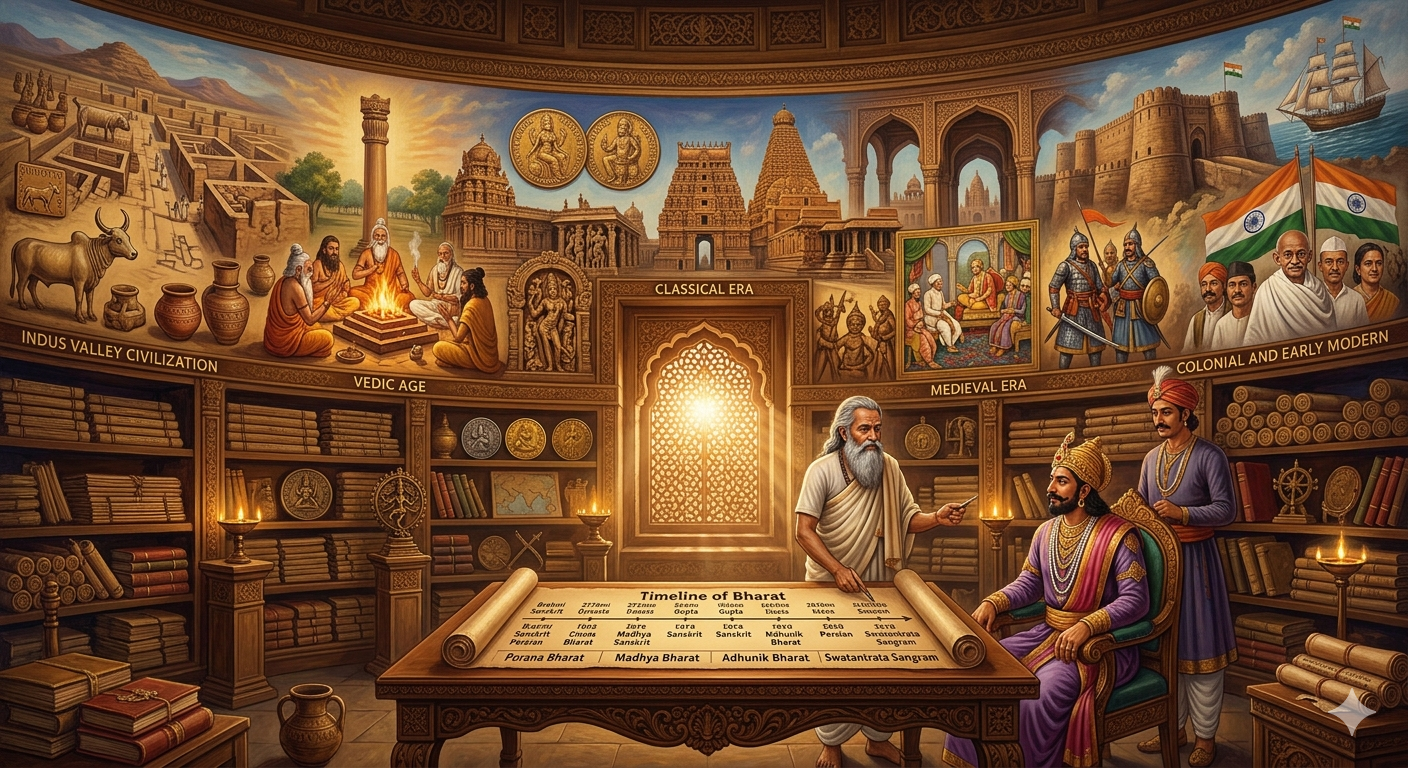
To correct the mistakes of colonial historians, modern Indian historians adopted a different system of periodization. This system focuses on broader changes in society, economy, and culture, rather than just the religion of the kings. Today, the History of Bharat is broadly divided into three main periods:
1. Ancient India
This period begins with the earliest human settlements and extends to roughly the 8th century CE. It covers the foundation of Indian civilization.
Key Features: This era witnesses the rise and fall of the Indus Valley Civilization, the writing of the Vedas, the birth of major religions like Buddhism and Jainism, and the establishment of vast early empires like the Mauryas and the Guptas.
2. Medieval India
The term “medieval” means “middle age.” In India, this period roughly spans from the 8th century CE to the 18th century CE.
Key Features: This era is characterized by the rise of powerful regional kingdoms (like the Cholas and the Rajputs), followed by the establishment of the Delhi Sultanate and the Mughal Empire. It was a time of immense cultural synthesis, where Indian traditions blended with Central Asian and Persian influences in art, architecture, and administration.
3. Modern India
This period generally begins around the mid-18th century, marked by the decline of the Mughal Empire and the rise of the British East India Company.
Key Features: The Modern period is defined by British colonial rule, the economic exploitation of the subcontinent, the introduction of Western education and railways, and, most importantly, the unified national freedom struggle that ultimately led to India’s independence in 1947.
A Historical Debate: Is “Modern” the Right Word?
It is important for students to note a major historical debate regarding the word “Modern.” In European history, the “Modern” period is associated with the growth of science, reason, democracy, liberty, and equality.
However, during the “Modern” period in India, the country was under British subjugation. Indians did not have liberty, equality, or economic prosperity. Because the realities of this time contradict the true meaning of “modernity,” many modern historians prefer to call this period Colonial India instead.
The Debate on Indian Periodization
As we saw with James Mill’s rejected classification, dividing history into neat boxes is never a simple task. Today, the most common periodization of Indian history is the division into the Ancient, Medieval, and Modern periods. However, this system is not perfect. In fact, it is the center of an ongoing and important debate among historians.
The core of this debate revolves around a simple question: Can we use a timeline created for European history to accurately tell the story of India?
The Problem with a “Eurocentric” View
The “Ancient, Medieval, Modern” system is Eurocentric. This means it was originally designed to describe the historical changes that happened in Europe, viewing the world strictly from a European perspective.
In European history, these terms have very specific meanings:
- Ancient: The time of great early civilizations, like Greece and Rome.
- Medieval: A middle period, often associated with the “Dark Ages,” marked by a decline in science, art, and centralized government after the fall of the Roman Empire.
- Modern: A period that began with the Renaissance, characterized by the growth of science, reason, democracy, liberty, and human rights.
When historians tried to copy and paste these European labels onto the “History of Bharat,” they quickly ran into major contradictions.
The Debate Over the “Medieval” Period
A major issue arises with the term “Medieval.” If a student uses the European definition, they might assume this middle period was a time of decline, lack of progress, and darkness.
However, the so-called “Medieval” period in Indian history (roughly the 8th to 18th centuries CE) was quite the opposite.
- Economic Wealth: During this time, India was one of the richest regions in the world, dominating global trade in textiles, spices, and precious stones.
- Cultural Brilliance: It was an era of magnificent architectural achievements, ranging from the grand Brihadeeswara Temple built by the Cholas in the south to the Taj Mahal built by the Mughals in the north.
- Intellectual Growth: Regional languages, literature, music, and new spiritual paths like the Bhakti and Sufi movements flourished across the subcontinent.
Because India’s “middle” period was so vibrant and wealthy, many historians argue that calling it “Medieval” is highly misleading. It forces a negative European concept onto a highly productive and dynamic era of Indian history.
The “Modern” vs. “Colonial” Controversy
An equally intense debate surrounds the term “Modern India,” which generally refers to the period of British rule from the mid-18th century until independence in 1947.
As noted earlier, “modernity” is defined by the arrival of freedom, equality, scientific reasoning, and economic progress. Yet, during this exact period, India experienced the exact opposite:
- Loss of Liberty: Indians were subjects of a foreign empire, stripped of self-rule and basic democratic rights.
- Economic Exploitation: Indian wealth, raw materials, and resources were drained to fuel Britain’s Industrial Revolution, often leaving the local population facing severe poverty and man-made famines.
- Inequality: The social and political structure was deeply unequal, with British officials holding absolute power over the native population.
Therefore, classifying this era of subjugation as “Modern” is a factual contradiction. To be more accurate and honest about the past, contemporary academic historians strongly prefer the term Colonial Period. This term directly describes the true reality of the time: a period defined by the political and economic control of India by a foreign imperial power.
The Introduction of Transitional Periods
To solve the problems created by these rigid, imported categories, modern historians have started using smaller, more flexible blocks of time known as transitional periods.
For example, instead of making a sudden, unrealistic jump from the “Ancient” to the “Medieval” world, historians now study the Early Medieval Period (roughly 600 CE to 1200 CE). This label acknowledges that societies do not change completely overnight. The decline of the great ancient empires like the Guptas slowly transitioned into the rise of powerful regional kingdoms like the Rashtrakutas, Palas, and Pratiharas, acting as a bridge between two major eras.
Understanding this debate is crucial for any student of history. It teaches us a vital lesson: periodization is a man-made tool, not a natural law. By questioning these historical labels, we avoid memorizing a distorted view of the past and gain a much deeper, more accurate understanding of India’s continuous journey through time.
How Did Ancient Indians Measure Time?
Just as periodization helps historians organize large blocks of history, calendars helped people in the past organize their daily lives, agriculture, and religious duties. A calendar is simply a system of organizing days, weeks, and months for social, commercial, or administrative purposes.
To fully understand the chronology of the “History of Bharat,” students must know how ancient Indian kings and societies recorded their dates. In ancient texts and inscriptions, you will rarely see dates written in the BCE or CE format that we use today. Instead, you will find dates recorded in different “Samvats” (the Sanskrit word for “era” or “year”).
The Science Behind the Calendars: Solar vs. Lunar
Before looking at specific calendars, it is important to understand how they are created. Throughout history, human beings have used two main objects in the sky to track time: the Sun and the Moon.
- Solar Calendar: This is based on the Earth’s orbit around the Sun. It takes about 365 days to complete one revolution. The modern calendar we use today is a solar calendar.
- Lunar Calendar: This is based on the Moon’s phases (from new moon to full moon). A lunar month is roughly 29.5 days, making a lunar year about 354 days long—which is 11 days shorter than a solar year.
If a society only uses a lunar calendar, their festivals will slowly drift into different seasons every year. To solve this, ancient Indian astronomers brilliantly designed Luni-Solar calendars. They used the Moon to track the months and dates, but occasionally added an extra month (called Adhik Maas) to synchronize the calendar with the Sun. This ensured that agricultural cycles and seasonal festivals, like Diwali or Holi, always occurred in the correct season.
Key Ancient Indian Calendar Systems
Indian history features numerous regional calendars, but two major systems became the most prominent and are still widely used today.
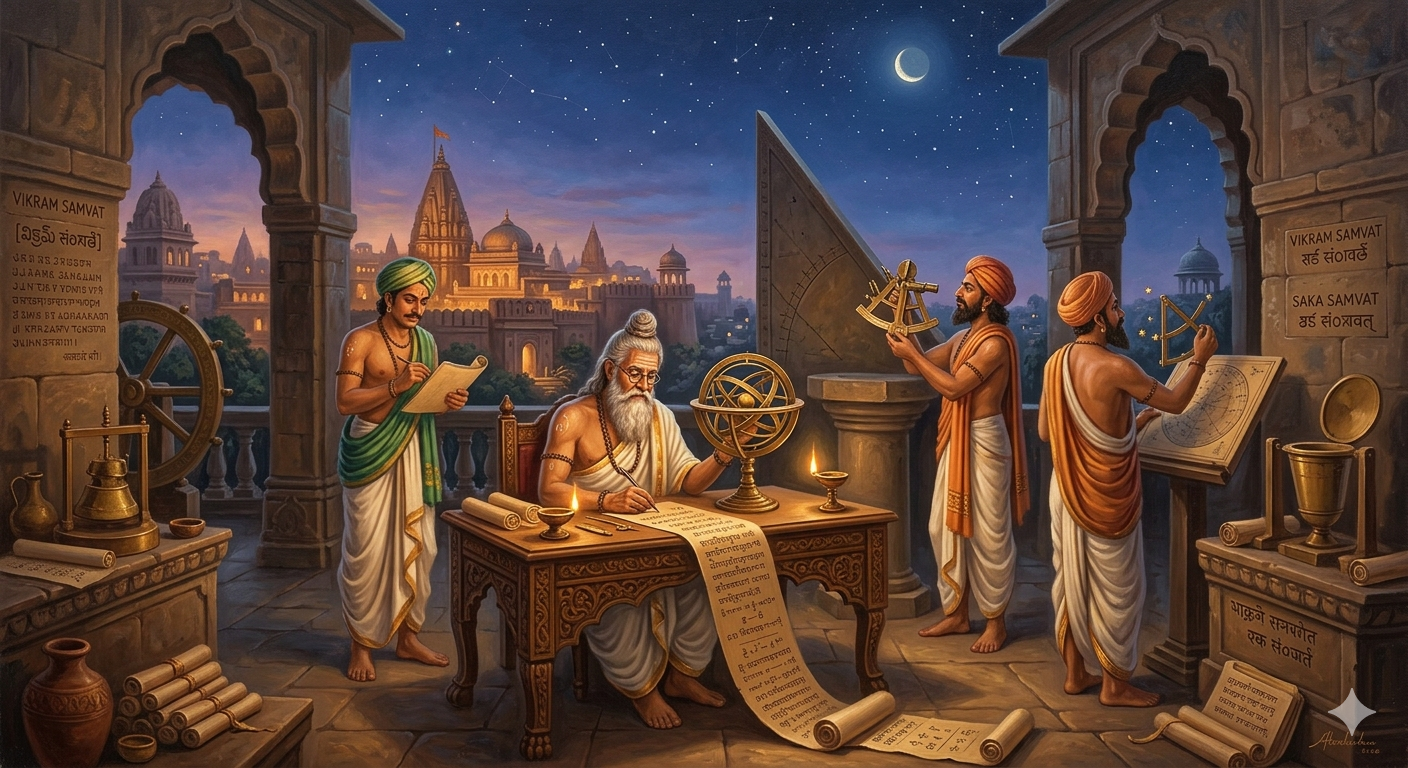
1. Vikram Samvat (57 BCE)
The Vikram Samvat is one of the oldest and most popular Hindu calendars.
- Background: According to historical tradition, it was established by King Vikramaditya of Ujjain.
- The Cause: It was created to celebrate his massive military victory over the Sakas (a group of foreign invaders) in 57 BCE.
- How it Works: Because it started 57 years before the Common Era (CE), the Vikram Samvat is always 57 years ahead of the modern calendar.
- Formula for Students: To convert a modern CE year to Vikram Samvat, simply add 57. For example, if the current year is 2024 CE, the Vikram Samvat year is 2081 (2024 + 57).
2. Saka Samvat (78 CE)
The Saka Samvat is another highly significant historical calendar, frequently found in ancient inscriptions and texts across India and even in Southeast Asia.
- Background: Historians generally believe this era was founded by Kanishka, the greatest emperor of the Kushana dynasty, when he ascended the throne.
- The Cause: It marked his coronation and the establishment of his powerful empire in 78 CE.
- How it Works: Because it started 78 years after the Common Era began, the Saka calendar is 78 years behind the modern calendar.
- Formula for Students: To find the Saka year, subtract 78 from the current CE year. If the modern year is 2024 CE, the Saka year is 1946 (2024 – 78).
The Arrival of New Calendar Systems
As India transitioned through different historical periods, new rulers brought new ways of keeping time.
The Hijri Calendar
During the medieval period, with the establishment of the Delhi Sultanate and the Mughal Empire, the Hijri calendar was introduced for administrative and religious purposes. This is a purely lunar Islamic calendar that begins in 622 CE, marking the year Prophet Muhammad migrated from Mecca to Medina. Because it does not add extra months to match the solar year, its dates shift backward through the seasons every year.
The Gregorian Calendar
With the arrival of the British and the beginning of the colonial period, the Gregorian calendar was introduced to India. Introduced globally by Pope Gregory XIII in 1582, this is a purely solar calendar. The British East India Company used it for all official, legal, and commercial paperwork. Because of British global dominance, the Gregorian calendar became the standard international system we still use for everyday business (January to December).
The Modern Era: The Indian National Calendar
When India gained independence in 1947, the new government faced a unique problem. The country was using the British Gregorian calendar for official work, but citizens were using over 30 different regional Hindu, Islamic, and Buddhist calendars for their personal and religious lives.
To bring unity and standardized timekeeping to the newly independent nation, the Calendar Reform Committee was established in 1952.
In 1957, the government officially adopted the Indian National Calendar.
- The Structure: The government chose the ancient Saka Samvat as the basis for the National Calendar because of its deep historical roots across the subcontinent.
- The Modern Adaptation: To make it practical for modern administration, it was perfectly aligned with the dates of the Gregorian calendar.
- Key Features: Its months are named in Sanskrit (Chaitra, Vaisakha, Jyeshtha, etc.). The new year officially begins on the 1st of Chaitra, which always falls on March 22nd in a normal Gregorian year (or March 21st in a leap year).
Today, the Indian government uses both the Gregorian calendar and the Indian National Calendar side-by-side for all official broadcasts, government documents, and communications.
Conclusion
In the study of history, time is the canvas on which the human story is painted. As we have explored throughout this article, understanding the “History of Bharat” requires much more than simply memorizing a list of dates. It requires a clear grasp of the systematic tools historians use to organize the past. Chronology provides the essential, step-by-step timeline, allowing us to trace the unbroken chain of cause and effect from early human settlements to the modern era. Periodization takes this massive timeline and carefully divides it into meaningful eras—Ancient, Medieval, and Colonial—helping us identify the major political, social, and economic shifts in society. At the same time, understanding the debates around periodization teaches us to think critically and reject outdated, colonial perspectives that do not fit India’s unique historical reality.
Furthermore, our look into ancient and modern calendar systems reveals that tracking time has always been deeply woven into India’s scientific, cultural, and administrative life. From the brilliant luni-solar calculations of the Vikram and Saka Samvats to the adoption of the standardized Indian National Calendar, the way a civilization measures its days and years reflects its profound connection to both nature and progress.
Ultimately, chronology, periodization, and calendars are not absolute laws of nature; they are vital, man-made frameworks designed to make sense of a vast and complex past. By understanding how these tools work, you are no longer just a passive reader of history. You are now equipped with the foundational academic skills necessary to analyze, question, and truly appreciate the magnificent, ongoing story of India.
FAQs (Frequently Asked Questions)
Sources & References
- R.S. Sharma – India’s Ancient Past
- Upinder Singh – A History of Ancient and Early Medieval India: From the Stone Age to the 12th Century
- Romila Thapar – Early India: From the Origins to AD 1300
- Satish Chandra – History of Medieval India
- Bipan Chandra – History of Modern India
- James Mill – The History of British India
- Amartya Sen – The Argumentative Indian
- Calendar Reform Committee (Government of India) – Report of the Calendar Reform Committee