Museums and Historical Institutions in India: Archaeology, Epigraphy, and Research Centers Guide
When we begin studying the history of India, we usually start by reading textbooks filled with dates, dynasties, and ancient battles. However, a crucial question often goes unasked: How do the authors of these textbooks know what happened thousands of years ago? History is not based on imagination; it is built on solid, physical evidence. Before a historical event can be written down for a student to study, its evidence must be physically discovered, carefully decoded, permanently preserved, and thoroughly analyzed.
This article explores the specialized organizations that perform this massive task: the historical institutions of Bharat. We will explore four key pillars of historical study. First, we will look at Museums, the institutions that preserve and display our cultural heritage. Next, we will understand Archaeological Institutions, the bodies responsible for scientifically excavating ancient sites. We will then explore Epigraphic Institutions, which decode the forgotten languages carved in stone and metal. Finally, we will examine Historical Research Centers, the academic hubs where scholars connect all this evidence to write the final story of human civilization.
Understanding these institutions is highly significant for any student or beginner. It transforms history from a simple list of memorized facts into a dynamic, living science. By learning how these centers operate, you will gain a clear understanding of exactly how the fascinating history of the Indian subcontinent is uncovered and protected for future generations.
Museums in India: Guardians of Bharat’s Heritage
To understand the history of India, reading books is not enough; we must also look at the physical objects left behind by our ancestors. This is where museums play a critical role. A museum is a specialized institution dedicated to collecting, preserving, studying, and displaying objects of historical, cultural, and scientific importance. In the context of Indian history, museums serve as the physical guardians of Bharat’s vast archaeological, epigraphical, and artistic wealth. They act as a bridge, connecting the modern generation with the ancient past by allowing us to see history with our own eyes.
The Origins of the Museum Movement in India
Historically, Indian kings and emperors maintained massive treasuries and royal collections of art, manuscripts, and weapons. However, the modern concept of a public museum—a place meant for scientific study and public education—was introduced during the colonial period.
The museum movement in India began in the early 19th century. The most important milestone was the establishment of the Indian Museum in Kolkata in 1814. It was founded by the Asiatic Society of Bengal, a group of early scholars dedicated to uncovering India’s past. The scholars realized that as they discovered ancient sculptures, coins, and inscriptions across the subcontinent, they needed a central, safe place to store and study them. This marked a shift in how Indian history was treated: moving away from casual treasure hunting toward systematic, academic preservation.
Categories of Historical Museums in India
As archaeological excavations increased across India, the sheer volume of discovered artifacts grew. To manage this wealth of history, different types of museums were established. For a student of history, it is helpful to understand two primary categories:
1. National and State Museums
These are large, centralized institutions that hold a wide variety of artifacts representing different eras and regions. They provide a comprehensive overview of Indian history.
- The National Museum in New Delhi is a prime example. It houses over two lakh (200,000) artifacts, ranging from the famous bronze “Dancing Girl” of the Indus Valley Civilization to intricate Mughal miniature paintings.
- State museums, such as the Government Museum in Chennai, focus heavily on regional history, preserving magnificent collections like the bronze statues of the Chola dynasty.
2. Archaeological Site Museums
A site museum is a highly specialized institution built directly at or very close to an archaeological excavation site. When archaeologists dig up an ancient city, moving the artifacts hundreds of miles away can strip them of their geographical context. Keeping them near the site helps visitors and scholars understand exactly where and how the objects were used.
- Sarnath Museum in Uttar Pradesh is a famous site museum. Built near the place where Gautama Buddha gave his first sermon, it houses the original Lion Capital of Ashoka (which is now India’s National Emblem).
- Lothal Museum in Gujarat sits beside the excavated ruins of an ancient Harappan port city, displaying beads, weights, and seals found exactly in that area.
The Role of Museums in Historical Research
Museums are not just storehouses; they are active research centers that make the writing of history possible. They contribute to our understanding of the past in three distinct ways:
Preservation and Conservation
India’s tropical climate—characterized by high heat and humidity—is very damaging to fragile historical materials like palm-leaf manuscripts, ancient textiles, and wooden carvings. Museums employ highly trained scientists called conservators. These experts use chemical treatments and climate-controlled display cases to stop the decay of artifacts, ensuring they survive for future generations.
Supporting Epigraphy and Numismatics
As mentioned in previous contexts, epigraphy is the study of ancient inscriptions, and numismatics is the study of ancient coins. Museums safely house these small, easily lost items. A single copper-plate inscription or a gold coin of the Gupta Empire can tell a historian about a king’s lineage, the economy of the time, or a forgotten trade route. By gathering these items in one place, museums allow researchers to compare scripts and dates, slowly piecing together the broken puzzle of Indian dynastic history.
Public Education and Visual History
Finally, museums transform abstract historical facts into a tangible reality. When a beginner reads about the advanced urban planning of the Indus Valley Civilization, it remains an idea in their head. But when they visit a museum and see the perfectly baked bricks, standardized weights, and intricate seals from 4,500 years ago, the concept becomes immediately clear. By carefully organizing exhibits in chronological order, museums teach the step-by-step evolution of human civilization in the Indian subcontinent.
Archaeological Institutions: Discovering and Protecting the Past
While museums serve as the safe keepers and display centers for historical artifacts, we must ask: how do these objects reach the museum in the first place? This brings us to the crucial role of archaeological institutions. An archaeological institution is a formal organization composed of trained experts—such as archaeologists, historians, and scientists—dedicated to locating, excavating (scientifically digging), and protecting the physical remains of the past.
If museums are the display windows of history, archaeological institutions are the active detectives working in the field to uncover it.
The Foundation of the Archaeological Survey of India (ASI)
To understand archaeological institutions in Bharat, we must look at the largest and most important one: the Archaeological Survey of India (ASI).
In the 18th and early 19th centuries, the exploration of India’s ancient ruins was largely disorganized. British officers and amateur explorers often dug up sites looking for treasure or beautiful sculptures, completely destroying the delicate historical context in the process. To stop this destruction and bring scientific order to the study of India’s past, the ASI was established in 1861.
The first Director-General of the ASI was Alexander Cunningham, a British army engineer with a deep passion for Indian history. He is widely remembered as the “Father of Indian Archaeology.” Under Cunningham, the ASI began systematically surveying northern India, carefully mapping out ancient Buddhist sites, stupas, and forgotten trade routes based on the travel accounts of ancient Chinese pilgrims. The creation of the ASI was a massive turning point: it transformed Indian archaeology from a destructive hobby into a disciplined, government-backed science.
Core Functions of Archaeological Institutions
What exactly do these institutions do on a day-to-day basis? Their work goes far beyond simply digging in the dirt. They have three primary responsibilities that help historians write accurate history:
1. Scientific Excavation and Exploration
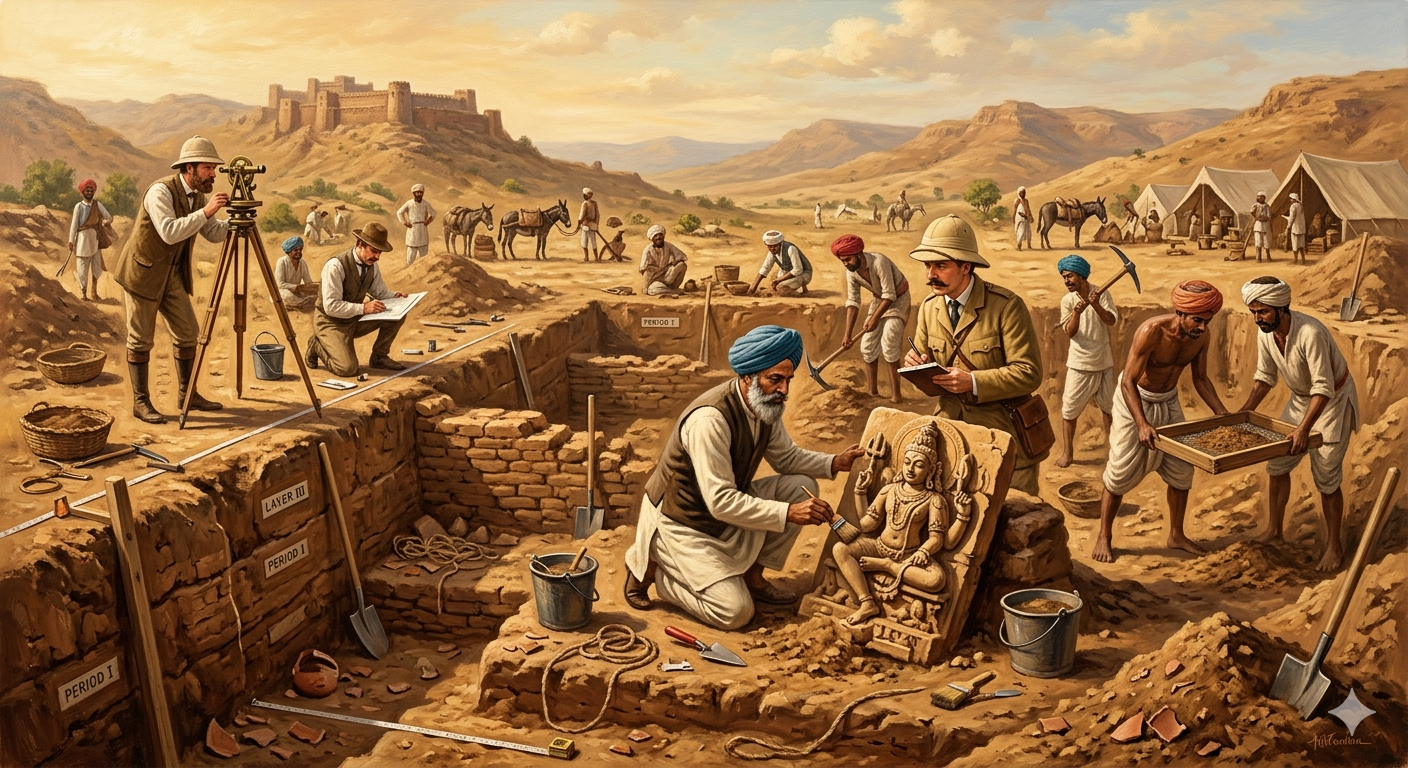
Institutions do not dig randomly. They use scientific methods, such as studying satellite maps, ancient texts, and soil patterns, to locate potential historical sites. When they do dig, they use a method called stratigraphy—digging layer by layer. Because older civilizations are buried deeper underground, studying these layers helps archaeologists create an accurate timeline. By carefully recording exactly where an object like a pot or a coin was found, institutions provide historians with solid evidence of how people lived at specific points in time.
2. Monument Conservation and Preservation
Not all history is buried underground. India is home to thousands of standing ancient structures, from the towering temples of Hampi to the rock-cut caves of Ajanta and Ellora. A major function of the ASI and similar institutions is conservation. This means repairing and chemically treating these ancient buildings to protect them from pollution, weather, and human damage. Without the constant care of these institutions, many of India’s greatest architectural achievements would simply crumble into dust.
3. Specialized Research Branches
Large institutions like the ASI have dedicated branches for specialized historical work. For example, they maintain an Epigraphy Branch (to decode and translate ancient inscriptions) and a Prehistory Branch (to study the Stone Age tools of early humans). This ensures that every type of historical evidence gets the expert attention it deserves.
Beyond the ASI: State Departments and Universities
While the ASI is the premier national organization, India’s historical landscape is too vast for one institution to manage alone.
To assist in this massive task, every Indian state has its own State Department of Archaeology. These state-level institutions focus on excavating regional sites and protecting local monuments that might not fall under national jurisdiction.
Furthermore, University Departments play a highly significant role. Institutions like Deccan College in Pune or the Banaras Hindu University (BHU) have dedicated archaeology and ancient history departments. They act as independent research centers. More importantly, university institutions are responsible for teaching and training the next generation of archaeologists, ensuring that the scientific exploration of Bharat’s history continues into the future.
Epigraphic Institutions: Decoding the Written Past
While archaeological institutions excavate ancient sites to uncover physical objects, they frequently find stones, pillars, copper plates, and temple walls covered in ancient writing. To understand these writings, we rely on epigraphic institutions. Epigraphy is the scientific study of inscriptions—which are texts carved into hard, durable surfaces rather than written on fragile paper or leaves. Therefore, an epigraphic institution is a specialized research center dedicated entirely to finding, copying, deciphering (decoding), translating, and publishing these ancient texts.
If archaeologists uncover the physical body of history, epigraphists give it a voice.
Why Do We Need Specialized Epigraphic Centers?
You might wonder why regular historians cannot simply read these ancient carvings. The answer lies in the evolution of language. Thousands of years ago, people in the Indian subcontinent wrote in scripts (alphabets) such as Brahmi and Kharoshthi, or used ancient, heavily modified versions of Sanskrit, Tamil, and Kannada. Over centuries, these scripts were completely forgotten.
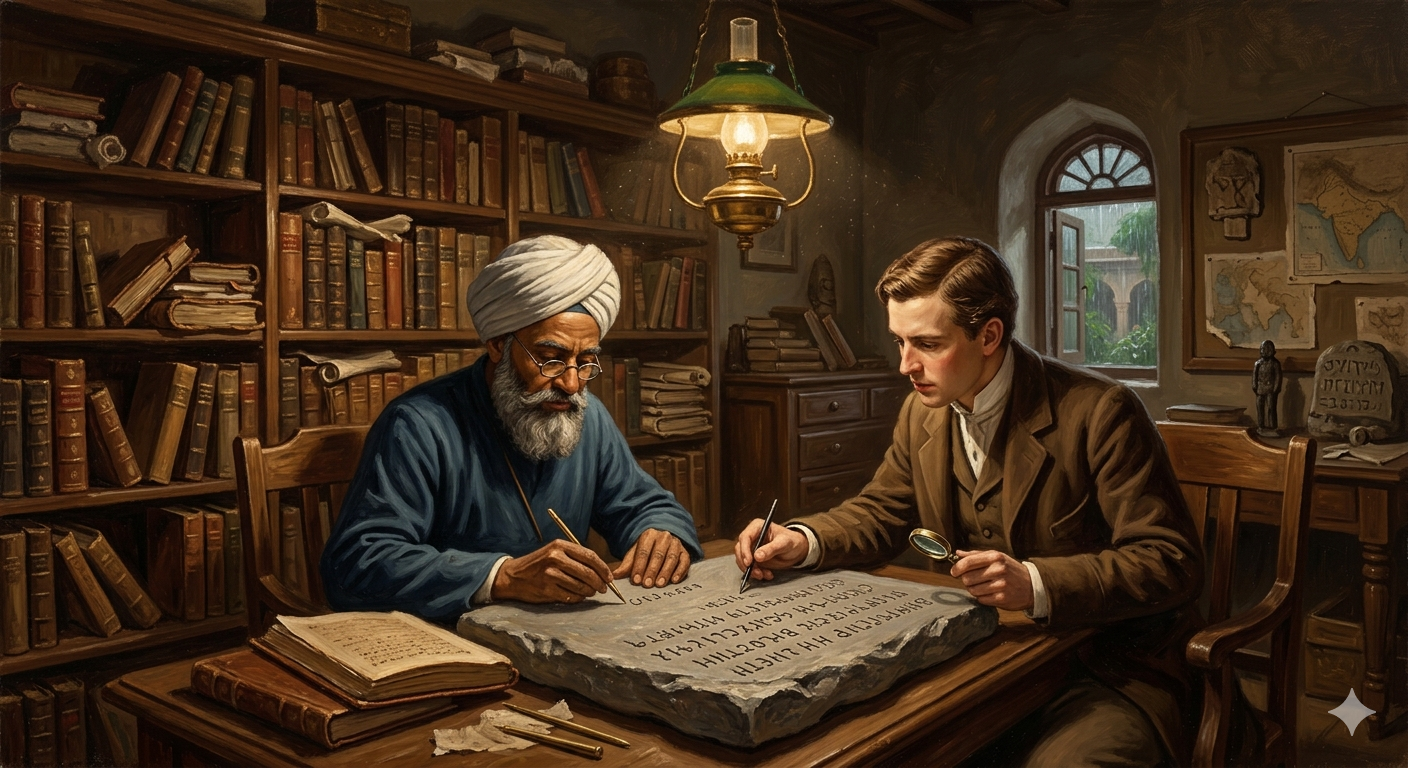
Before the 19th century, no one in India could read the ancient pillars standing in places like Delhi or Sarnath. Epigraphic institutions were created to solve this problem. They gather linguistic experts who spend years studying how alphabet shapes change over time. These scholars act as historical translators, turning mysterious carvings into readable historical records.
The Epigraphy Branch of the ASI
The most important epigraphic institution in Bharat is the Epigraphy Branch of the Archaeological Survey of India, primarily headquartered in Mysuru (Mysore).
As the ASI began exploring India in the late 1800s, they realized that southern India, in particular, had tens of thousands of inscriptions carved onto the walls of massive stone temples. Because there were simply too many inscriptions to study on-site, a dedicated epigraphic branch was established. Its primary goal was to systematically record every inscription found across the country, categorize them by language and dynasty, and translate them for historians to use.
How Epigraphic Institutions Work: The Estampage Method
How do scholars study an inscription carved onto a massive temple wall or a heavy stone pillar without bringing the stone back to the museum? They use a highly effective technique called making an estampage.
An estampage is a highly accurate paper copy of an inscription. The process is simple but requires great skill:
- Scholars thoroughly clean the inscribed stone.
- They press heavy, wet paper directly onto the carved letters, gently beating it with a specialized brush so the paper sinks into the carved grooves.
- Once the paper is tightly pressed, they dab black ink over the surface.
- The flat surface of the stone catches the black ink, but the sunken grooves of the letters remain white.
When the paper is peeled off and dried, the epigraphists have a perfect, black-and-white copy of the inscription. Epigraphic institutions store tens of thousands of these estampages in their archives, allowing scholars to study ancient texts from air-conditioned offices rather than standing in the hot sun.
Publication and Historical Impact
Once an inscription is translated, the knowledge must be shared with the academic world. Epigraphic institutions accomplish this by publishing academic journals. The most famous of these in India is Epigraphia Indica, a journal that has been publishing official translations of Indian inscriptions since 1888.
The impact of these institutions on our understanding of Indian history cannot be overstated. For example, before scholars deciphered the Brahmi script, Emperor Ashoka the Great was almost entirely forgotten by history. It was only when epigraphists translated his rock edicts (royal orders carved on stones) that the world realized the vast extent of the Mauryan Empire and Ashoka’s policies of Dhamma (righteousness). Similarly, the translation of thousands of Chola dynasty copper-plate inscriptions has given us detailed, step-by-step knowledge of how ancient Indian village assemblies and local economies functioned. Through the steady work of epigraphic institutions, the silent stones of Bharat have been made to speak.
Historical Research Centers: Writing the Story of Bharat
We have seen how archaeological institutions dig up physical objects and how epigraphic institutions decode ancient writings. However, raw objects and translated texts do not automatically become a history textbook. Someone has to connect all these pieces of evidence to form a complete and accurate narrative. This is the primary role of Historical Research Centers.
A historical research center is a specialized academic institution where historians, scholars, and students gather to analyze evidence, debate ideas, and write history. If archaeologists and epigraphists gather the raw materials of the past, research centers are the workshops where the final story of human civilization is carefully crafted.
Why Do We Need Specialized Research Centers?
You might ask why a historian cannot simply write a book from their own home. The answer is that serious historical research requires vast resources that an individual rarely possesses. Writing accurate history is a complex process that demands:
- Access to rare, out-of-print books and original government documents.
- Financial support to travel to distant excavation sites or foreign archives.
- A community of fellow experts who can review, criticize, and improve the research before it is published.
Research centers provide this vital environment. They act as the intellectual hubs of historical study, ensuring that the history taught to the public is based on solid, verified evidence rather than myths or guesswork.
Core Functions of Research Centers
To understand how these institutions operate, it is helpful to look at their day-to-day functions. Most major historical research centers focus on three key areas:
1. Funding and Fellowships
Conducting historical research can take years. Research centers provide financial grants and fellowships (stipends) to scholars. This allows researchers to dedicate their full time to reading, traveling, and writing without worrying about basic financial survival.
2. Maintaining Specialized Archives
While museums display objects to the public, research centers maintain closed archives for scholars. These archives hold delicate paper records, such as centuries-old land deeds, personal letters of freedom fighters, and old newspaper collections.
3. Publishing Academic Journals
Once a historian makes a new discovery, they must share it with the academic world. Research centers publish peer-reviewed journals. “Peer-reviewed” means that before an article is printed, other expert historians read it to check for factual errors or weak arguments.
Key Historical Research Centers in India
India is home to several world-class research centers, each specializing in different periods or methods of history. For a student, knowing a few major examples helps clarify how historical work is divided:
The Indian Council of Historical Research (ICHR)
Established in 1972 in New Delhi, the ICHR is the premier government body that guides and funds historical research across the country. It does not teach classes like a university. Instead, it provides massive grants to historians, funds the translation of important historical books into regional Indian languages, and organizes national seminars where scholars can present their latest findings.
Bhandarkar Oriental Research Institute (BORI)
Located in Pune and founded in 1917, BORI is a legendary institution focusing on Indology—the academic study of Indian history, literature, philosophy, and culture. BORI is famous for preserving tens of thousands of ancient paper and palm-leaf manuscripts. Its most celebrated achievement was the creation of the “Critical Edition” of the Mahabharata. Scholars at BORI spent decades comparing hundreds of different regional versions of the epic to identify the oldest, most accurate original text, proving how research centers organize scattered ancient knowledge.
The Prime Ministers’ Museum and Library (PMML)
While BORI focuses on ancient India, the PMML (formerly the Nehru Memorial Museum and Library) in New Delhi is the ultimate research center for modern Indian history. It holds the largest collection of resources related to India’s freedom struggle. If a historian wants to write a book about the Indian National Movement, they will spend months at the PMML studying the private diaries, official letters, and original photographs of India’s early political leaders.
Through institutions like these, the raw data of the past is slowly and carefully transformed into the structured history that helps us understand the continuous evolution of Bharat.
Conclusion
The journey of understanding India’s past is not a single, simple step; it is a highly coordinated, scientific process. As we have explored in this guide, the reconstruction of history relies on a continuous chain of dedicated institutions working together. It begins in the dirt with archaeological institutions unearthing the physical remains of forgotten cities. It continues with epigraphic centers giving a voice to those remains by translating silent stone inscriptions. This raw evidence is then handed over to historical research centers, where scholars carefully analyze the data to write accurate, factual narratives. Finally, museums serve as the grand protectors and educators, safely housing these treasures and presenting them to the public.
The core concept to take away is that history is deeply interconnected. An excavated clay pot is just a broken piece of earth until an archaeologist dates it, a researcher studies its trade origins, and a museum displays it to tell the story of ancient commerce. One institution cannot function effectively without the others.
The broader significance of these historical organizations cannot be overstated. They are the ultimate guardians of Bharat’s vast and diverse heritage. Without their systematic and scientific efforts, our ancient monuments would crumble, our forgotten scripts would remain unread, and our past would be lost to myth and decay. By preserving the truth of our ancestors, these institutions ensure that the foundation of our civilization remains strong, visible, and deeply understood for centuries to come.
FAQs (Frequently Asked Questions)
Sources & References
- Upinder Singh – A History of Ancient and Early Medieval India: From the Stone Age to the 12th Century
- D. C. Sircar – Indian Epigraphy
- Dilip K. Chakrabarti – A History of Indian Archaeology from the Beginning to 1947
- John Keay – India Discovered: The Recovery of a Lost Civilization
- Tapati Guha-Thakurta – Monuments, Objects, Histories: Institutions of Art in Colonial and Post-Colonial India
- Sourindranath Roy – The Story of Indian Archaeology 1784–1947
- Archaeological Survey of India – Epigraphia Indica