How History Is Interpreted: Scientific Methods, Analysis, and Historiography in Indian History
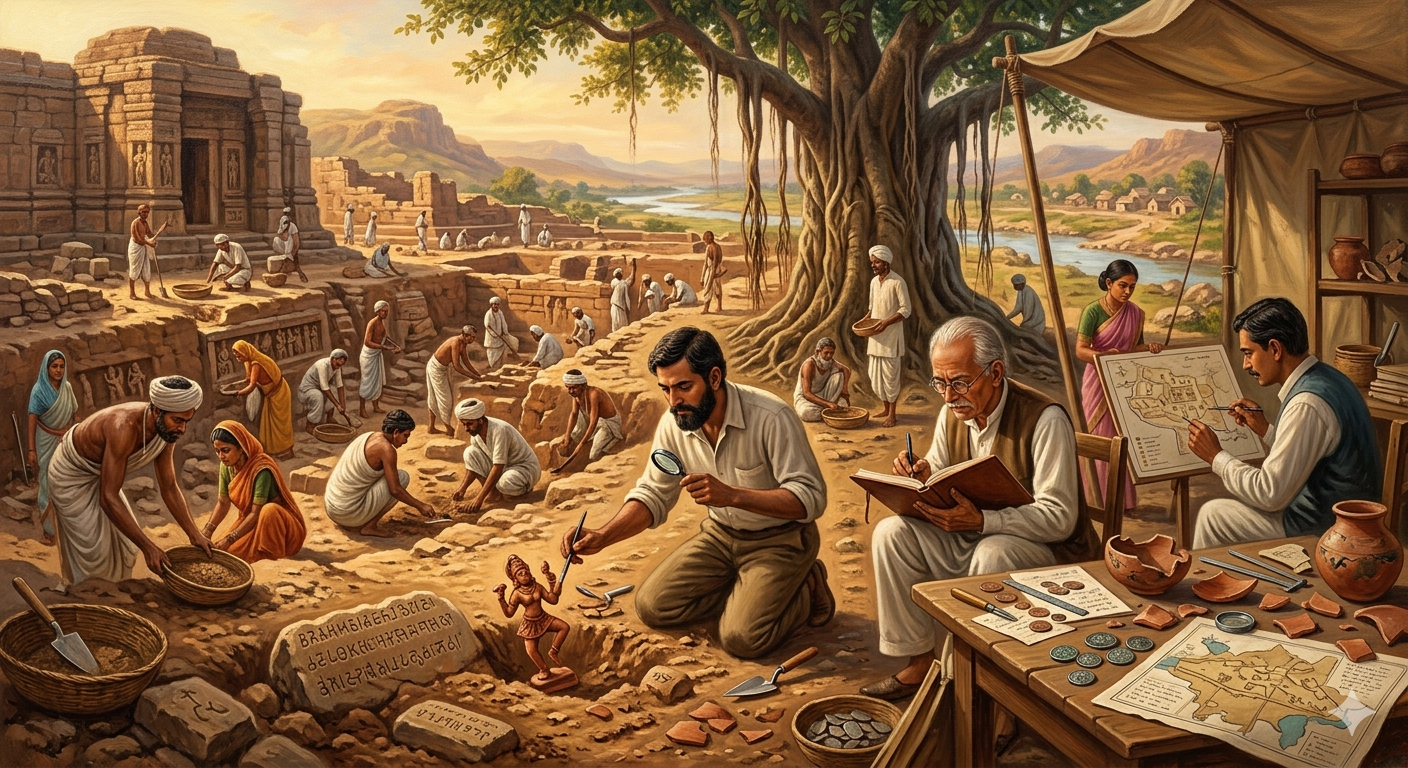
When we read a history book, it is easy to assume that the events described are just simple facts from the past, permanently fixed and unchanging. However, history is not merely a long list of dates, kings, and battles meant to be memorized. It is an ongoing, active investigation. How do we actually know what happened thousands of years ago when no one alive today was there to witness it? The answer lies in how historical evidence is discovered, analyzed, and ultimately interpreted.
In the study of history, interpretation is the careful process of making sense of the clues left behind by our ancestors. It is the bridge between a raw piece of evidence—like a buried clay pot, an ancient coin, or a faded manuscript—and the rich, detailed stories we read in our textbooks.
This article will guide you through the fascinating journey of how Indian history is constructed. First, we will explore the scientific and technical tools, such as radiocarbon dating and archaeogenetics, that historians use to establish reliable timelines and physical facts. Next, we will examine the analytical methods that help experts connect these facts to understand the deeper “why” and “how” of historical events. Finally, we will introduce the concept of historiography—the study of how history itself is written—by exploring the different viewpoints or “schools of thought” that have shaped the narrative of Bharat over the last two centuries.
Whether you are a student preparing for academic or competitive exams, or simply a beginner curious about the past, understanding these methods is highly valuable. It transforms history from a subject of blind memorization into a dynamic exercise in critical thinking, showing you exactly how the story of our civilization is pieced together.
Scientific and Technical Methods of Interpretation
History is often thought of as the study of old texts and written records. However, texts can sometimes be biased, incomplete, or damaged. To build a more accurate and objective picture of the past, modern historians act much like detectives, relying heavily on scientific and technical methods.
When historians and archaeologists discover an artifact—whether it is a piece of human bone, a broken clay pot, or a rusty metal sword—they cannot simply guess its age or origin. They must use specialized scientific techniques to extract factual data from these objects. This section explores the primary scientific tools historians use to date, analyze, and interpret historical evidence, particularly in the context of Indian history.
Establishing Chronology: The Science of Dating the Past
Before a historian can interpret an event, they must first know exactly when it happened. Chronology is the science of arranging events in their correct order of time. To establish a reliable timeline, historians rely on absolute dating methods, which provide a specific age or date range for an object.
Radiocarbon Dating (Carbon-14 or C-14 Analysis)
This is one of the most revolutionary scientific tools used in history. All living things—humans, animals, and plants—absorb a radioactive isotope called Carbon-14 while they are alive. When the organism dies, it stops absorbing Carbon-14, and the existing carbon slowly begins to decay (break down) at a known, predictable rate.
By measuring the exact amount of Carbon-14 left in organic remains (like wood, charcoal, seeds, or bones), scientists can calculate how long ago the organism died.
Impact on Indian History: Radiocarbon dating completely transformed our understanding of the Indus Valley Civilization (Harappan Civilization). Before C-14 dating, historians could only guess the age of Harappan cities based on their trade with Mesopotamia. Radiocarbon dating provided hard, scientific proof that the mature phase of the Indus Valley Civilization thrived between 2600 BCE and 1900 BCE, firmly anchoring ancient Indian history on a reliable timeline.’
Thermoluminescence (TL Dating)
While Carbon-14 is excellent for organic materials, it cannot be used on inorganic materials like clay or pottery. To date ancient ceramics, scientists use Thermoluminescence.
When clay is fired in a kiln to make pottery, the extreme heat traps tiny particles of light energy inside the object. Over centuries, as the pottery sits buried in the ground, it slowly absorbs background radiation from the earth, trapping more energy. When scientists reheat a sample of this pottery in a laboratory, it releases the trapped energy as a flash of light. By measuring the brightness of this light, they can determine exactly how many thousands of years have passed since the pot was originally made.
Impact on Indian History: TL dating has been crucial in interpreting the early iron-age cultures of the Ganga Valley. By dating specific types of pottery, such as Painted Grey Ware (PGW) and Northern Black Polished Ware (NBPW), historians have been able to map how early towns and trade routes expanded across North India during the Vedic and Mahajanapada periods.
Analyzing Material and Technology: Archaeometallurgy
Beyond knowing when an object was made, historians also need to know how it was made and where the materials came from. Archaeometallurgy is the scientific study of ancient metal use, extraction, and manufacturing.
Through chemical analysis, scientists can determine the exact composition of metal artifacts like coins, weapons, and tools. They look for “trace elements”—tiny impurities in the metal that act like a fingerprint, pointing directly back to the specific geographic mine where the metal ore was originally dug up.
Impact on Indian History: Chemical analysis of the famous Iron Pillar of Delhi, which dates back to the Gupta period (circa 400 CE), revealed a high phosphorus content and a unique protective rust layer. This scientific interpretation proved the highly advanced metallurgical skills of ancient Indian blacksmiths, correcting earlier assumptions that such technology was unavailable in the ancient world. Similarly, testing the metal purity of Gupta-era gold coins has helped historians track periods of economic prosperity and later economic decline.
Uncovering Human Ancestry: Archaeogenetics and Ancient DNA (aDNA)
In recent years, the most groundbreaking technical method added to the historian’s toolkit is Archaeogenetics—the study of ancient DNA.
By extracting genetic material from the teeth or ear bones of ancient skeletons, scientists can map the entire genetic code of a person who lived thousands of years ago. This allows historians to trace the movement of human populations, understand how different groups migrated and intermingled, and even discover what diseases ancient people suffered from.
Impact on Indian History: Ancient DNA analysis has been central to resolving long-standing historiographical debates regarding the peopling of the Indian subcontinent. For example, DNA extracted from skeletons at the Harappan site of Rakhigarhi has provided historians with direct genetic evidence about the ancestry of the Indus Valley people. This scientific data allows historians to rely on biological facts rather than just interpreting ambiguous ancient texts when discussing human migrations in early India.
Discovering the Hidden Landscape: Remote Sensing and GIS
Sometimes, historical evidence is buried deep underground or is spread out over such a massive area that it cannot be seen from the ground level. To interpret the broader historical landscape, historians use Remote Sensing (using satellite imagery) and Ground-Penetrating Radar (GPR).
GPR works by sending radar pulses into the ground to detect buried walls, roads, or foundations without digging a single hole. Geographic Information Systems (GIS) software then helps historians layer this data over modern maps to analyze the spatial relationship between ancient cities, natural resources, and trade routes.
Impact on Indian History: Satellite imagery has been vital in interpreting the geography of ancient northwestern India. Using remote sensing, scientists and historians have mapped the dried-up paleochannels (ancient riverbeds) of the Ghaggar-Hakra river system, often identified with the Sarasvati River mentioned in early texts. This technical mapping helped explain why so many mature Harappan settlements were clustered in a region that is now a desert, proving that the drying up of major rivers played a significant role in the decline of the Indus Valley Civilization.
Analytical and Historiographical Interpretation
In the previous section, we explored how scientific tools provide historians with reliable facts, such as the precise age of an artifact or the origins of an ancient population. However, raw data and established timelines do not automatically tell a complete story. A carbon-dated coin tells us when it was made, but it does not tell us why the economy crashed or how the common people lived. To make sense of the facts, historians must move beyond science and use analytical and historiographical interpretation.
This section explores how historians connect the dots between raw evidence to understand the deeper meanings, causes, and consequences of historical events.
What is Historical Analysis?
Historical analysis is the logical process of examining evidence to understand causes, effects, and historical context. It is the step where a historian asks “why” and “how” rather than just “what” and “when.”
When historians analyze an event, they do not look at it in isolation. They examine multiple dimensions—political, social, economic, and cultural. For example, consider the rock edicts (inscriptions) of Emperor Ashoka. Scientific methods can confirm the inscriptions belong to the 3rd century BCE. However, historical analysis is required to understand why Ashoka placed them across the Indian subcontinent. By analyzing the text, a historian can deduce that Ashoka was using these edicts not just for religious purposes, but as a political tool to unify a vast, diverse empire under a common moral code (Dhamma).
Understanding Historiography: The “History of History”
A crucial part of historical analysis is understanding that history is never entirely objective. A historian is a human being, and their perspective is shaped by the time they live in, their personal beliefs, and their political views. This brings us to a vital concept: Historiography.
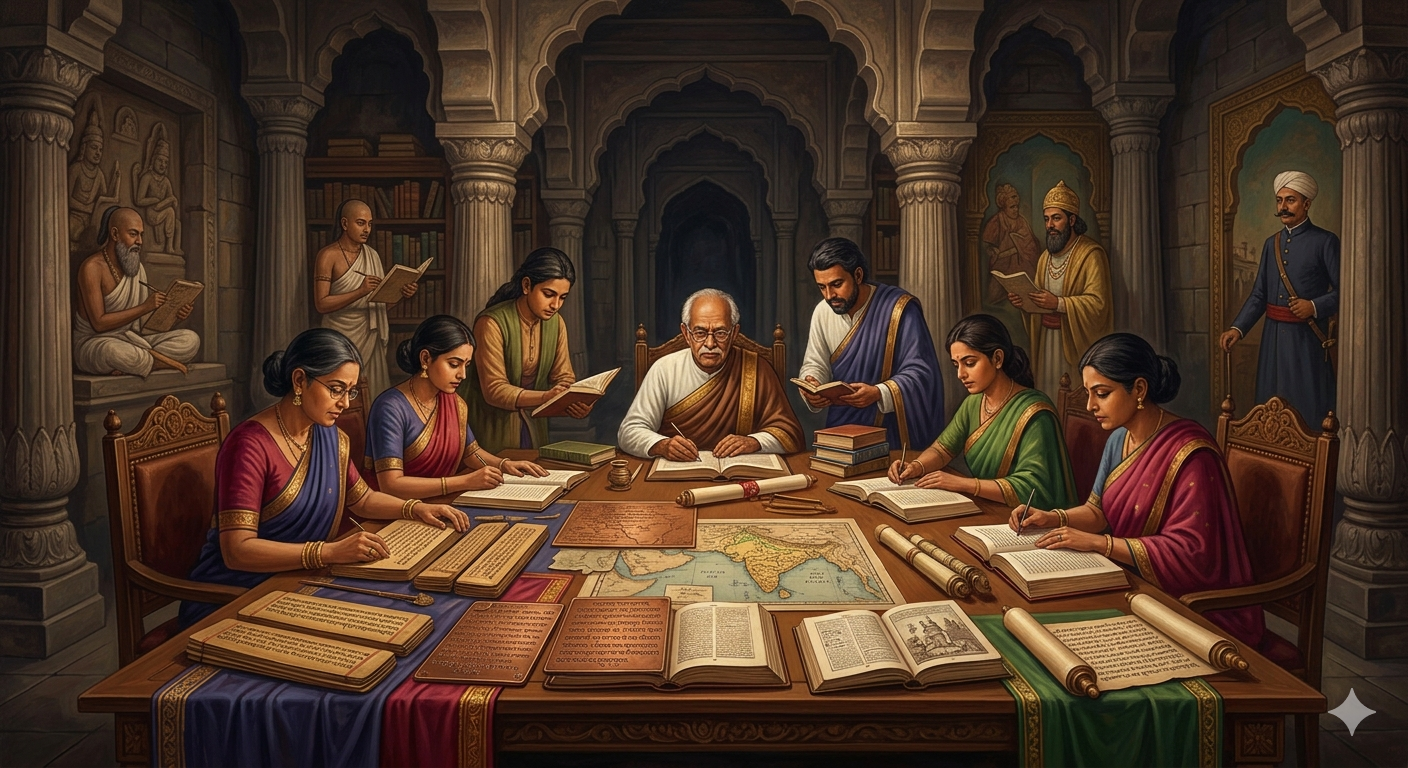
Historiography, in simple terms, is the study of how history is written. It is the “history of history.” It recognizes that two different historians can look at the exact same set of facts and write two completely different stories. By studying historiography, students learn not just what happened in the past, but how our understanding of the past has changed over time.
To truly understand the history of Bharat, one must understand the different “schools” or approaches of historiography that have shaped how Indian history is taught and read today.
Major Schools of Indian Historiography
Over the last two centuries, Indian history has been interpreted through several distinct lenses. Each approach highlights different types of evidence and focuses on different groups of people.
1. The Colonial (or Imperialist) Approach
This was the first modern, systematic attempt to write Indian history, pioneered by British officials and scholars in the 18th and 19th centuries.
- The Perspective: Colonial historians, such as James Mill, largely viewed India as a stagnant, backward society that lacked political unity and scientific progress.
- The Motive: The underlying purpose of this interpretation was to justify British colonial rule. By painting ancient India as primitive and divided, they argued that British administration was necessary to bring civilization and order to the subcontinent. Mill notoriously divided Indian history into three distinct, religion-based periods: Hindu, Muslim, and British—a flawed classification that caused long-term historical misunderstandings.
2. The Nationalist Approach
As the Indian independence movement gained momentum in the late 19th and early 20th centuries, Indian historians began to reject the biased colonial narratives.
- The Perspective: Nationalist historians, such as R.C. Majumdar and R.K. Mookerji, scoured ancient texts and archaeological findings to highlight India’s historical achievements. They focused on proving that ancient India had strong, unified empires, advanced philosophies, and prosperous economies.
- The Impact: This school of thought was crucial in building national pride and uniting the masses against British rule. For example, they heavily highlighted the “Golden Age” of the Gupta Empire and the existence of democratic republics (Mahajanapadas) in ancient India to prove that Indians were highly capable of self-governance.
3. The Marxist Approach
By the mid-20th century, a new generation of historians felt that both the Colonial and Nationalist schools were too focused on kings, dynasties, and religion. They introduced the Marxist approach to Indian history.
- The Perspective: Scholars like D.D. Kosambi and R.S. Sharma shifted the focus entirely toward economics, material wealth, and social classes. They argued that the real driving force of history is not the decisions of great kings, but the struggle over land, resources, and labor.
- The Focus: Instead of just praising the Gupta Empire’s art and literature, a Marxist historian analyzes the condition of the peasants and the oppressive nature of the caste system during that same period. This approach brought the lives of ordinary workers and farmers into the historical spotlight.
4. The Subaltern Approach
The word “subaltern” refers to people of a lower rank or class. Emerging in the 1980s, led by historians like Ranajit Guha, the Subaltern school argued that even the Marxist historians were too focused on elite leaders and formal organizations.
- The Perspective: Subaltern historians focus on the voices of the absolute lowest sections of society—peasants, tribal communities, and marginalized laborers—whose perspectives are usually completely ignored in official government records.
- The Impact: For example, when analyzing the Revolt of 1857, a Subaltern historian does not focus on the strategies of Rani Lakshmibai or Bahadur Shah Zafar. Instead, they examine the folk songs, rumors, and local grievances of the common foot soldiers and village peasants to understand why ordinary people chose to risk their lives and rebel.
By applying these different analytical frameworks, historians ensure that the history of Bharat is not just a single, static timeline, but a rich, multi-dimensional study of human society from every possible angle.
Conclusion
The writing of history is a complex, multi-layered process that goes far beyond simply recording old events. As we have seen, uncovering the truth about the past requires a careful balance of hard science and thoughtful human analysis. By using advanced tools like radiocarbon dating, archaeometallurgy, and ancient DNA analysis, modern historians are able to establish exact timelines and undeniable physical facts, laying a solid, objective foundation for their research.
However, scientific data alone cannot explain human motivations, economic struggles, or cultural shifts. This is where analytical interpretation and historiography become essential. By applying different historiographical lenses—whether Colonial, Nationalist, Marxist, or Subaltern—historians are able to examine the exact same set of facts from multiple angles. This comprehensive approach ensures that the “History of Bharat” is not just the story of powerful kings and elite rulers, but also includes the economic realities of ordinary workers, the movements of ancient populations, and the voices of the marginalized.
Ultimately, the broader significance of understanding how history is interpreted lies in developing critical thinking. It teaches us that no single historical narrative is absolute or perfect. Our understanding of the past is continuously refined as scientific methods advance and new generations of historians ask different questions. By learning how to approach history through these scientific and analytical frameworks, we are better equipped to appreciate the true depth, diversity, and dynamic nature of India’s incredible past.
FAQs (Frequently Asked Questions)
Sources & References
- Upinder Singh – A History of Ancient and Early Medieval India: From the Stone Age to the 12th Century
- Romila Thapar – The Penguin History of Early India: From the Origins to AD 1300
- D.D. Kosambi – An Introduction to the Study of Indian History
- E. Sreedharan – A Textbook of Historiography: 500 BC to AD 2000
- R.C. Majumdar – The History and Culture of the Indian People
- Ranajit Guha – Subaltern Studies: Writings on South Asian History and Society
- Tony Joseph – Early Indians: The Story of Our Ancestors and Where We Came From