Evolution of Sources in Indian History: Ancient, Medieval, and Modern Evidence Explained
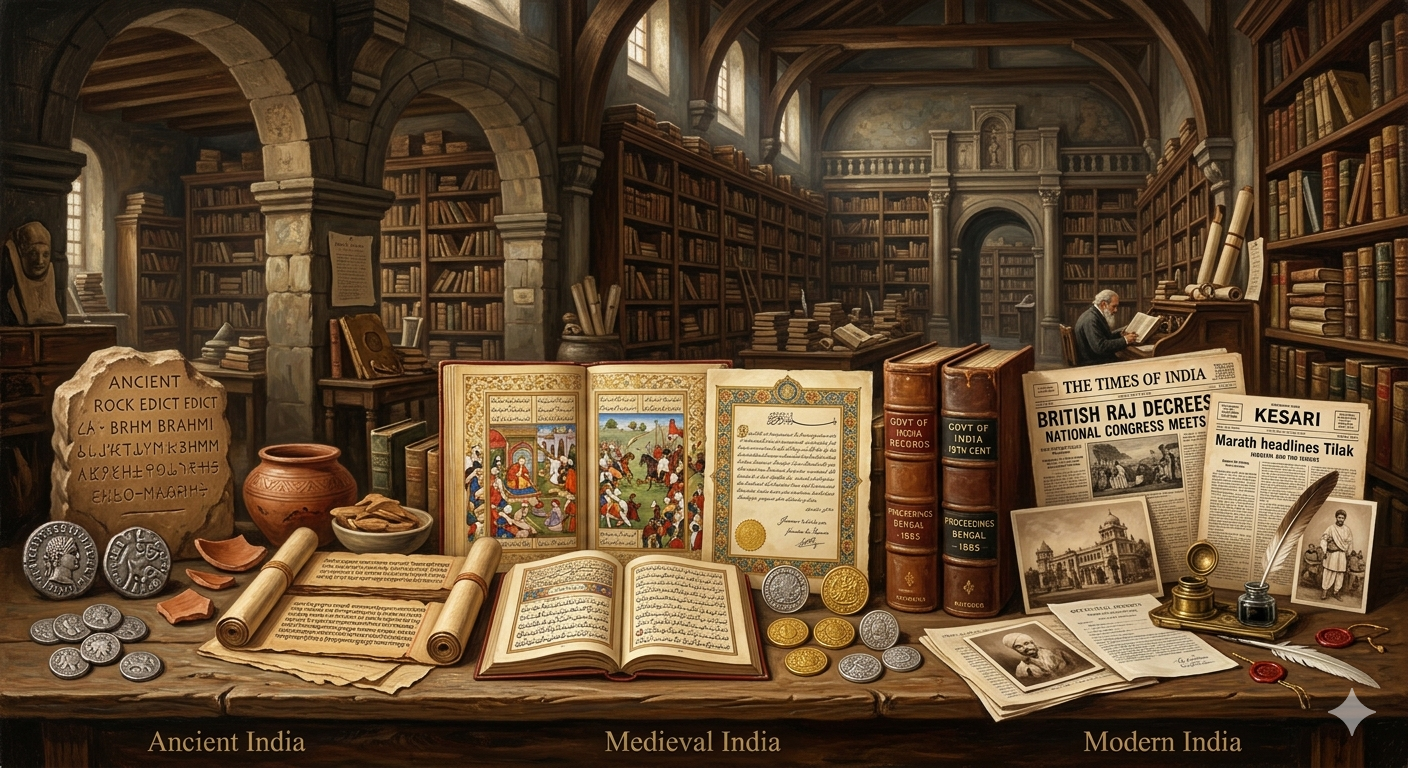
History is not simply a collection of stories about the past; it is a complex puzzle reconstructed using clues left behind by our ancestors. These clues are what historians call “sources.” Simply put, a historical source is any piece of evidence—whether a physical object, a written document, or an oral tradition—that provides information about a bygone era. Without these sources, history would just be guesswork. However, the types of clues people left behind did not remain the same throughout time. As human society changed, so did the ways in which people recorded their lives.
This article explores the fascinating journey of how historical evidence has evolved in the Indian subcontinent. We will walk step-by-step through three major eras: the Ancient, Medieval, and Modern periods. You will see how humanity transitioned from leaving behind silent archaeological ruins and memorized hymns, to writing detailed medieval court chronicles, and finally to generating massive modern government archives and newspapers.
Understanding the evolution of these sources is fundamentally important for anyone starting their journey in history, especially school students and competitive exam aspirants. It teaches us a crucial lesson: learning history is not just about memorizing what happened, but understanding how we know it happened. By studying how sources changed, we learn how to evaluate the reliability, limitations, and biases of the evidence that shapes our understanding of India’s past.
Sources of Ancient Indian History
When we study the ancient period of Indian history, the types of evidence we use do not remain the same from beginning to end. As human society evolved from early hunter-gatherers to city-dwellers, and eventually to massive empires, the ways people left behind traces of their lives also changed. In this section, we will explore how historical sources evolved throughout the ancient period, shifting from silent physical objects to spoken hymns, and finally to detailed written records and foreign accounts.
The Earliest Beginnings: Relying on the Earth (Pre-Historic and Harappan Phases)
In the deepest past, before the invention of writing, historians have only one way to understand human life: physical remains. During the pre-historic Stone Age and the later Indus Valley Civilization (Harappan phase), historians rely almost entirely on archaeology.
The people of the Indus Valley Civilization did have a script, which we see on thousands of their steatite seals. However, because modern scholars have not yet been able to decipher (read) this script, it cannot function as a literary source. Therefore, our understanding of this highly advanced urban culture comes entirely from how they built their cities, the pottery they used, the burial sites they left behind, and their drainage systems. In this earliest phase of ancient history, the sources are purely material and “silent,” requiring historians to piece together the past like a giant physical puzzle.
The Shift to Oral Traditions: The Vedic Age
As we move into the Vedic period (around 1500 BCE to 600 BCE), the nature of our sources undergoes a dramatic shift. Unlike the Harappans, who left behind grand brick cities, the early Vedic people were primarily semi-nomadic and pastoral. They built with wood and natural materials that decayed over time, leaving us with very little physical, archaeological evidence.
Instead, the primary source for this era is an enormous body of literature: the Vedas. However, there is a unique feature to this source—it was not initially written down. It was passed down through a strict oral tradition known as Shruti (meaning “that which is heard”). Generations of priests memorized these hymns with perfect pronunciation and passed them to the next generation. For historians, this presents a unique challenge. While the Vedas provide a brilliant, detailed window into the religion, society, and philosophy of the time, it is very difficult to attach exact dates to oral traditions because they were written down on palm leaves centuries after they were composed.
The Rise of Empires: Inscriptions and Coins Enter the Scene (Mauryan Era)
Around the 4th and 3rd centuries BCE, as large kingdoms and empires began to form, the administration of the state became complex. Kings needed to communicate with vast numbers of subjects spread across huge territories. This necessity led to one of the most important evolutions in ancient historical sources: the widespread use of decipherable inscriptions.
Emperor Ashoka of the Mauryan Empire was the first Indian ruler to leave extensive written records. He carved his royal orders, moral teachings (Dhamma), and administrative policies directly onto massive stone pillars and rock surfaces across the Indian subcontinent.
Because these edicts were written in the Brahmi script—which was successfully deciphered by James Prinsep in 1837—historians no longer have to guess what the ruler was thinking. We hear the direct “voice” of the king.
During this same post-Vedic and Mauryan period, we also see the evolution of coins. Early Indian coins were simple “punch-marked” pieces of silver or copper, stamped with symbols like trees or bulls. While useful for understanding trade, they told us little about the rulers. But as ancient India interacted with outsiders, such as the Indo-Greeks, coins evolved. They began to feature the faces of kings, their names, and dates. This evolution in numismatics (the study of coins) allowed historians to perfectly reconstruct the timelines of entire dynasties that would have otherwise been forgotten.
The Classical Age: A Flourishing of Texts and Outsider Perspectives (Gupta Period and Beyond)
By the time we reach the Gupta Empire (around the 4th to 6th centuries CE), the sources of ancient history mature into a rich, diverse collection of evidence. Writing was no longer restricted just to religious hymns or royal commands.
The Rise of the Prashasti
A new type of formal inscription became highly popular: the Prashasti. A Prashasti is a royal eulogy—a poem composed by a court poet specifically to praise a king’s achievements, military victories, and genealogy. A famous example is the Allahabad Pillar Inscription, composed by the poet Harishena to praise the Gupta ruler Samudragupta. While these are excellent sources for political history, historians must read them carefully, as court poets often exaggerated the greatness of their kings.
Secular Literature and Scientific Texts
During this period, our literary sources expanded beyond religious texts (like the Vedas or Puranas) into secular (non-religious) writing. We find dramas, poetry by Kalidasa, law books (Dharmashastras), and scientific treatises by astronomers like Aryabhata. This evolution gives historians a much more rounded picture of ancient society, showing us not just how people prayed, but how they entertained themselves, governed their families, and understood the stars.
The Arrival of Foreign Accounts
Finally, as ancient India became deeply connected to the rest of the world through trade and Buddhism, a new type of source emerged: the travelogues of foreign visitors. Greek ambassadors like Megasthenes (who wrote the Indica during the Mauryan period) and later Chinese Buddhist pilgrims like Fa-Hien and Xuanzang visited India and wrote detailed accounts of what they saw. These foreign accounts are incredibly valuable because they provide an outsider’s perspective on Indian society—often noticing and recording everyday cultural habits that local Indian writers thought were too obvious or common to write down.
Sources of Medieval Indian History
As we transition from the ancient to the medieval period (roughly the 8th to the 18th century CE), the nature of historical evidence undergoes a massive transformation. While ancient Indian sources were often religious, philosophical, or composed long after the events took place, the medieval period brings us into an era of deliberate, precise record-keeping. The single most important evolution during this time is the explosion of written literature specifically intended to record history, largely driven by the introduction of paper and new cultural traditions of historiography (the writing of history).
The Rise of Court Chronicles: Tarikh and Tawarikh
One of the most significant shifts in medieval historical sources was the introduction of the Islamic tradition of history-writing. Unlike ancient texts, which often blended myth with reality, the scholars accompanying the Delhi Sultans and later the Mughals brought a systematic approach to recording dates, events, and political decisions.
These formal historical records are known as Tarikh (singular) or Tawarikh (plural), an Arabic word meaning “history” or “chronicle.” Written primarily in Persian—the official language of the medieval courts—these texts were commissioned by the rulers themselves. A famous example is the Akbarnama, written by Emperor Akbar’s court historian, Abul Fazl.
How Historians Use Them: While these chronicles provide incredible detail about battles, administrative policies, and royal family trees, historians must read them with a critical eye. Because they were written by court employees, Tawarikh heavily praised the ruling kings and often ignored the struggles of the common peasants. Nevertheless, they offer a firm, chronological backbone for medieval Indian history that was largely missing in the ancient period.
The Personal Voices of Rulers: Autobiographies
While ancient kings like Ashoka spoke to us through stone edicts, some medieval rulers picked up the pen and wrote their own life stories. This gave rise to a new type of source: the royal autobiography.
The most famous example is the Baburnama, the highly personal diary of Babur, the founder of the Mughal Empire. Unlike a court poet who might flatter the king, Babur wrote frankly about his military failures, his homesickness, and his observations of India’s climate, wildlife, and people. This evolution gives historians rare, unfiltered access to the psychology and personal motivations of a historical figure.
A Linguistic Shift: Regional Languages and Devotional Texts
While Persian dominated the royal courts, another major evolution was happening among the common people. In the ancient period, elite literature was primarily composed in Sanskrit. However, during the medieval period, we see a massive rise in literature written in regional languages like Marathi, Bengali, Tamil, and Hindi.
This shift was largely driven by the Bhakti and Sufi movements—devotional religious trends that emphasized a personal connection with God, rather than complex rituals. Saints and poets composed songs and poetry in the languages of the common people so everyone could understand them. While these texts (like the Abhangs in Maharashtra or the Vachanas in Karnataka) are religious in nature, they are vital historical sources. They tell us “how” the common people lived, what their social structures looked like, and how they protested against rigid caste rules, providing a necessary balance to the elite court chronicles.
A Broader Worldview: The Surge of Foreign Travelers
Foreign accounts existed in ancient India, but their volume and diversity exploded during the medieval period. Because of India’s immense wealth and its central position in global maritime trade, a steady stream of Arab, Persian, and eventually European travelers, merchants, and ambassadors arrived on its shores.
These visitors left behind detailed travelogues. For example, the Moroccan traveler Ibn Battuta provided brilliant insights into the justice system and postal networks of the Delhi Sultanate in the 14th century. Later, European travelers like the French physician François Bernier wrote extensively about Mughal cities and economies. These accounts are crucial because these foreigners noticed things that locals took for granted—such as the exact layout of markets, the specific goods traded, and the daily habits of ordinary citizens.
The Evolution of Material Evidence: Epigraphy and Numismatics
Even with the abundance of written records, material evidence continued to evolve and remain crucial.
Copper-Plate Grants
Inscriptions did not disappear, but their medium and purpose shifted. Especially in South India, under empires like the Cholas, kings issued thousands of land grants. Instead of carving these onto rocks, they engraved them onto portable copper plates linked with a royal seal. These plates are exceptional sources for understanding medieval village administration, taxation, and the transfer of wealth to temples and Brahmins.
Medieval Coinage
Coins also transformed dramatically. Ancient Indian coins often featured images of deities or the faces of kings. However, following Islamic traditions that forbid the depiction of living beings, the coins of the Delhi Sultanate and the Mughal Empire evolved to feature beautiful Arabic and Persian calligraphy. These coins contained the name of the ruler, the date of issue, and the location of the mint. By mapping where these coins are found today, historians can accurately trace the expanding borders of medieval empires and the reach of their trade networks.
Sources of Modern Indian History
As we transition from the medieval era into the modern period—beginning roughly in the mid-18th century with the rise of British power—the volume and variety of historical sources undergo an explosive expansion. While medieval history heavily relied on court chronicles written by royal employees to praise kings, modern history is characterized by massive, systematic administrative data and, crucially, the voices of ordinary people. This era marks a shift from relying on the personal records of the elite to examining highly organized, institutional evidence.
The Bureaucratic State: Official Government Archives
The most defining feature of modern Indian historical sources is the overwhelming presence of official government records. When the British East India Company, and later the British Crown, took control of India, they introduced a deeply bureaucratic system of administration.
Because the British were ruling a vast, unfamiliar country from thousands of miles away in London, every policy, military movement, and administrative decision had to be meticulously written down, debated, and sent back and forth as official dispatches. This created a mountain of paperwork—memos, reports, letters, and policy documents. Today, millions of these documents are carefully preserved in the National Archives of India in New Delhi and the India Office Records in London.
How Historians Use Them: These archives provide unparalleled, day-to-day details on how the government functioned, how the economy was managed, and how laws were made. However, historians must read these records cautiously. Because they were written by colonial administrators, these documents reflect a British perspective. To uncover the true Indian experience, historians often have to read these official files “against the grain”—looking for hidden biases or reading between the lines to understand how Indians resisted colonial rule.
Measuring and Mapping: Surveys and the Census
To control, tax, and govern India effectively, the British needed to understand exactly what the country looked like and who lived in it. This necessity led to the creation of entirely new types of historical evidence: scientific surveys and the census.
The British established institutions like the Survey of India to map the physical geography of the subcontinent with scientific precision. They also conducted detailed revenue surveys to understand land ownership and agricultural output. Most significantly, starting in 1881, the British government began conducting a regular, nationwide Census every ten years.
For historians, the census is a revolutionary source. Unlike medieval texts that rarely mentioned the common peasant, census data provides hard, quantitative (number-based) evidence about population growth, caste demographics, occupations, and literacy rates across the entire country.
The Information Revolution: The Printing Press and Newspapers
While the government was creating its own records, an entirely different kind of source was emerging among the Indian public, thanks to the introduction of the printing press. Before this, texts had to be laboriously copied by hand. The printing press allowed information to be mass-produced cheaply and quickly.
This led to the birth of modern Indian journalism. Newspapers, journals, and pamphlets became the primary tools for social reformers and freedom fighters to spread their ideas. Publications like The Hindu, Amrita Bazar Patrika, and Mahatma Gandhi’s Harijan were published in both English and regional languages. These newspapers are invaluable to historians because they track the day-to-day evolution of the Indian national movement, public debates on social reforms (like the abolition of Sati), and the growing political awareness of the Indian masses.
The Democratization of History: Personal Letters and Autobiographies
In the ancient and medieval periods, usually only kings or high-ranking nobles left behind personal accounts. In the modern period, the writing of history became democratized—meaning it was opened up to a much wider range of people.
Nationalist leaders, social reformers, and ordinary citizens began writing detailed autobiographies, diaries, and personal letters. For instance, Mahatma Gandhi’s autobiography, The Story of My Experiments with Truth, or the extensive correspondence between Jawaharlal Nehru and Sardar Patel, provide deep, psychological insights into the minds of the people who shaped modern India. These personal sources act as a necessary counterbalance to the cold, impersonal statistics of government files.
Capturing the Voices of the Unrecorded: Oral History
Despite the massive amount of written records in the modern period, many people—such as poor farmers, tribal communities, and women—remained illiterate and were largely left out of official documents. To capture their history, modern historians increasingly rely on oral history.
Oral history involves recording the memories, songs, and personal stories of people who lived through historical events. This source has proven especially critical for studying deeply traumatic human events, such as the Partition of India in 1947. Official government records tell us how the borders were drawn, but it is the oral histories—the painful interviews with refugees who crossed the border—that tell us the true emotional and human cost of that history.
A New Visual Dimension: Photography and Film
Finally, the late 19th and 20th centuries introduced entirely new visual and audio sources. The invention of the camera meant that historians no longer had to rely solely on paintings or descriptions to know what a place or person looked like. Archival photographs of the 1857 revolt, early documentary films of the freedom struggle, and voice recordings of speeches (like Nehru’s “Tryst with Destiny”) bring modern history to life in a way that was completely impossible in earlier eras.
Conclusion
The journey of Indian history is perfectly mirrored in the evolution of the sources we use to study it. As we have seen, the ancient period forces historians to rely heavily on silent archaeological remains, strictly memorized oral traditions, and eventually the public proclamations of kings carved into stone. The medieval period brought a clear shift toward systematic, deliberate history-writing, characterized by detailed Persian court chronicles (Tawarikh), the rise of regional devotional literature, and the keen observations of foreign travelers. Finally, the modern period represents an information explosion, dominated by highly organized British bureaucratic records, scientific census data, the printing press, and the personal, democratized voices of ordinary citizens and freedom fighters.
This evolution highlights a broader conceptual shift in human history: a steady movement from the undocumented to the heavily documented, and from the records of the absolute elite to the inclusion of the common people. As Indian society became more complex and interconnected, the methods of preserving information became significantly more diverse and detailed.
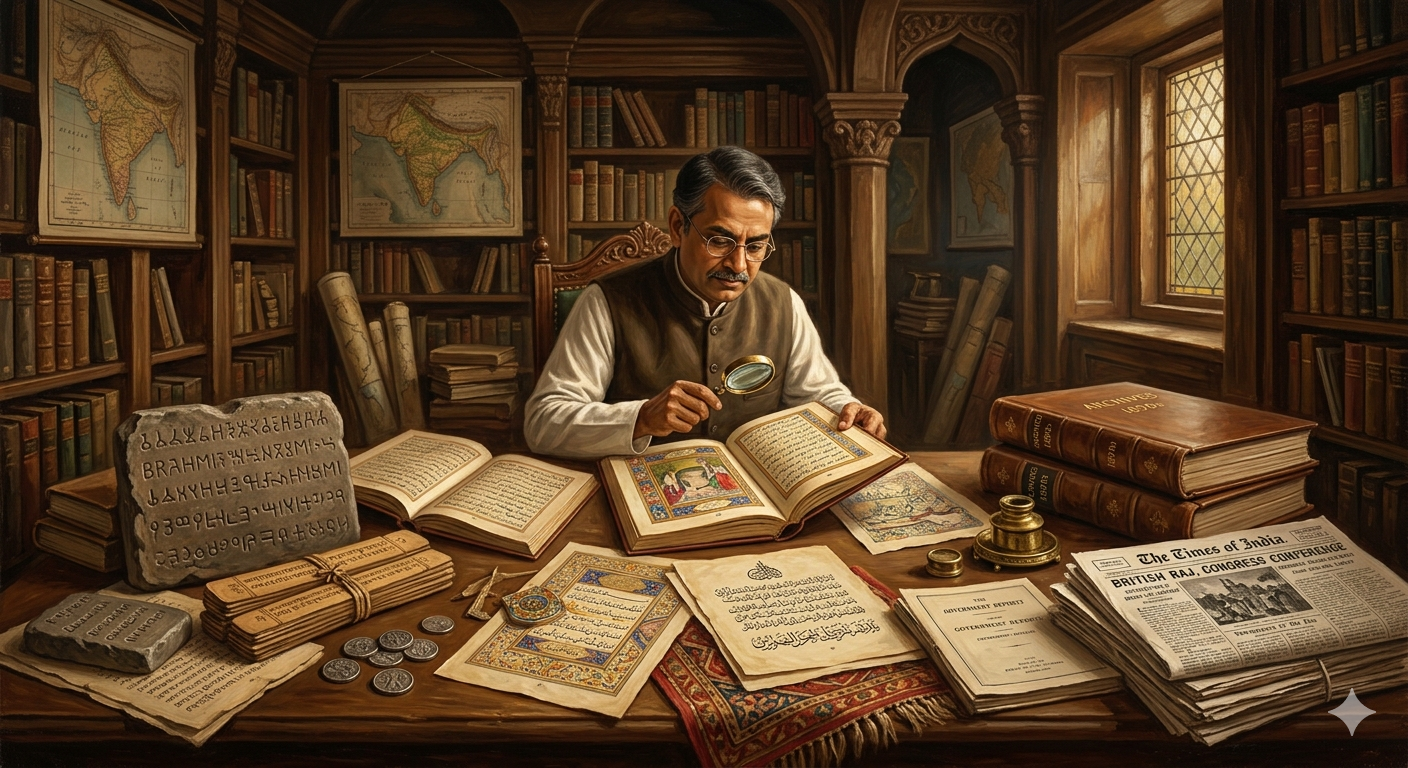
Recognizing this progression is vital for understanding the discipline of history as a whole. It reminds us that our view of the past is entirely shaped, and sometimes limited, by the nature of the surviving evidence. A historian studying the buried cities of the Indus Valley must use different skills than one reading a 19th-century newspaper. Ultimately, tracing the evolution of historical sources transforms us from passive readers into critical thinkers, proving that history is not a fixed list of facts, but an ongoing, evolving dialogue with the evidence of the past.
FAQs (Frequently Asked Questions)
Sources & References
- Upinder Singh – A History of Ancient and Early Medieval India
- Romila Thapar – Early India: From the Origins to AD 1300
- R.S. Sharma – India’s Ancient Past
- Satish Chandra – History of Medieval India
- Bipan Chandra – History of Modern India
- Sumit Sarkar – Modern India, 1885–1947
- The Edicts of Ashoka (Inscriptional Evidence)
- Abul Fazl – Akbarnama (Court Chronicle)
- Census of India Archives (Official Records)