Historiography in Indian History: Approaches and Types Explained for Students
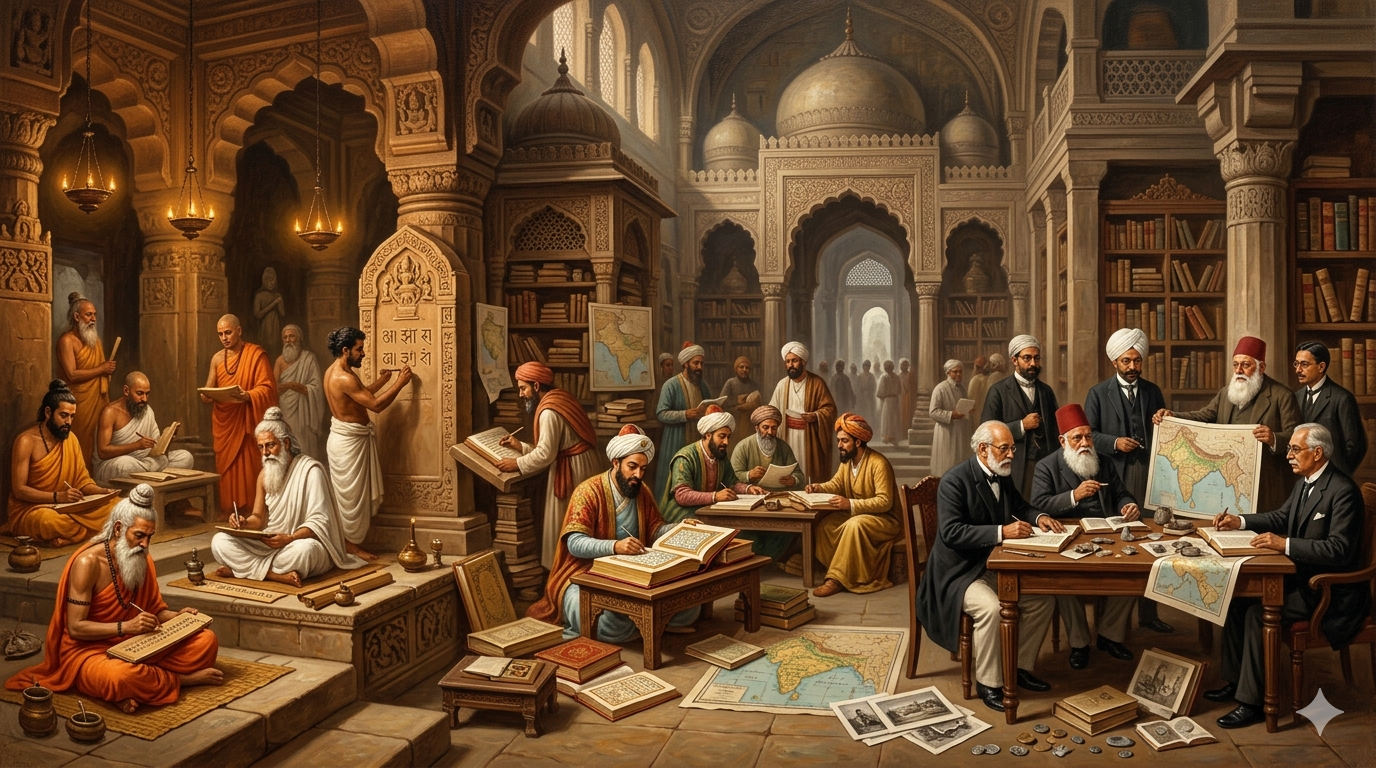
When we open a history textbook, it is easy to assume that the past is simply a fixed list of dates, kings, and wars. However, history is not just about what happened; it is also about how we remember and record what happened. This brings us to a fundamental concept in historical study: Historiography. In simple terms, historiography is the “history of history.” It is the study of how historians approach the past, the methods they use to organize facts, and the different perspectives they adopt when writing about historical events.
For students and competitive exam aspirants, understanding historiography is just as important as knowing historical facts. It teaches you that history is not a single, unquestionable story, but a dynamic field shaped by the historian’s viewpoint.
This article will guide you through the essential approaches and types of historiography used to study Indian history. We will begin by exploring the basic methods historians use to structure their writing, such as the chronological and thematic approaches. Next, we will examine the major historical traditions—from traditional political history to the groundbreaking subaltern and people’s histories that brought the voices of the common masses to light. Finally, we will look at subject-specific historiography, which focuses on specialized areas like literature, art, and science. By the end of this article, you will have a clear, step-by-step understanding of how the rich and diverse history of Bharat has been written over time.
Types of Historiography Based on Method and Approach
When historians look at the vast expanse of the past, the sheer amount of information—thousands of years of events, millions of lives, and countless social changes—can be overwhelming. To make sense of this massive collection of facts, historians must choose a framework to organize their writing. This chosen structure is known as their “method” or “approach.”
Based on how a historian decides to arrange and present historical evidence, historiography (the study of how history is written) can be broadly categorized into different types. Two of the most fundamental and widely used methods are Chronological Historiography and Thematic Historiography.
Chronological Historiography: Understanding the Timeline
The word “chronological” comes from the Greek word chronos, which means time. Chronological historiography is the practice of writing history organized entirely by the sequence of time. In this method, events are recorded, explained, and analyzed in the exact order that they occurred, moving from the earliest dates toward the present.
How It Works
Chronological historiography acts like a straightforward historical timeline. The primary focus is on answering the question: “What happened next?” For example, a historian writing a chronological history of ancient India will systematically start with the Indus Valley Civilization, progress to the Vedic Period, move on to the rise of the Mahajanapadas, and then cover the Mauryan and Gupta Empires in that exact order.
Examples and Evidence in Indian History
Most school textbooks use a chronological approach because it is the best way to help beginners build a mental map of the past. In terms of primary historical texts, a classic early example of chronological writing in India is the Rajatarangini, written by the Kashmiri scholar Kalhana in the 12th century CE. Unlike earlier mythological texts, Kalhana made a conscious effort to record the kings of Kashmir in a clear, continuous, and time-based sequence.
Significance and Limitations
This method is absolutely essential to the study of history because it establishes cause and effect. In history, an event can only be caused by something that happened before it. By laying out events on a timeline, students can see how the decline of one empire naturally led to the rise of another. However, a purely chronological approach has limitations. If a historian only focuses on the timeline of events, the writing can sometimes become a dry list of dates, kings, and wars, accidentally leaving out the rich details of how ordinary people lived, worshipped, or traded.
Thematic Historiography: Exploring Specific Subjects
To address the limitations of simply listing events over time, historians developed a second approach. “Thematic” means relating to a specific subject or theme. Thematic historiography organizes historical writing around a particular topic—such as the economy, religion, gender, art, or agriculture—rather than strictly following a timeline of political events.
How It Works
Instead of asking “What happened next?”, a thematic historian asks, “How did this specific aspect of human life develop during a certain period?” In this approach, a historian might look at an entire era, like the Mughal Period, but completely ignore the famous political battles unless they are relevant to the chosen theme. For instance, a thematic book titled Trade and Commerce in Mughal India will focus entirely on merchant guilds, coin minting, port cities, and trade routes.
Examples and Evidence in Indian History
In the mid-20th century, Indian historiography saw a massive shift toward the thematic approach. Historians like D.D. Kosambi and R.S. Sharma began writing extensively about the economic and social history of early India. Instead of writing about which king ruled after Ashoka, they analyzed how farming techniques improved, how the caste system evolved, and how trade networks expanded across the subcontinent.
Significance and Limitations
The thematic approach provides a much deeper and richer understanding of human society. It moves beyond the palaces of kings to explore the lives of peasants, artisans, and women. It helps us understand the underlying trends that shape societies over centuries. However, thematic historiography relies on a foundation of chronological knowledge. A student cannot fully grasp a thematic study on the “Economic Decline of the Gupta Empire” if they do not first know when the Guptas ruled and what chronological events led to their downfall.
Therefore, these two methods are not completely separate; rather, they rely on one another. Chronological historiography builds the structural skeleton of the past, while thematic historiography adds the flesh and blood of human experience.
Major Traditions in Indian Historiography
While chronological and thematic methods give historians a structure for their writing, the actual stories they choose to tell depend on their overall perspective. When a group of historians shares a similar perspective or focus over a period of time, it forms a “tradition” or a “school of thought.” In Indian historiography, as historians slowly realized that the past is much more than just a list of kings and battles, their focus shifted from the elite rulers at the top to the ordinary people at the bottom. This evolution led to the development of several distinct historical traditions.
Traditional Historiography: The Focus on Power and Politics
Traditional historiography is the oldest and most common way history has been written. It is a “top-down” approach, meaning it looks at society from the perspective of those at the very top of the social and political ladder. This tradition focuses primarily on political events, the rise and fall of empires, wars, treaties, and the lives of great leaders.
How and Why It Developed
For centuries, the easiest way to write history was to use the official records left behind by governments. Kings, emperors, and colonial administrators had the money and power to hire scribes to write down their achievements. Therefore, early historians naturally relied on these official documents, such as court chronicles (like the Akbarnama from the Mughal era) or British administrative reports.
Because it relied on these elite sources, traditional historiography paints a picture of the past where history is driven entirely by powerful individuals. While this approach is crucial for understanding how states and governments functioned, its major limitation is that it ignores the vast majority of the population who were not kings, generals, or wealthy merchants.
Social and Cultural Historiography: Broadening the Horizon
To correct the limitations of purely political history, the tradition of Social and Cultural Historiography emerged. This approach aligns closely with the thematic method discussed in the previous section. Instead of looking only at who held political power, social and cultural historians ask: “How did people live, think, and interact?”
Key Features and Focus
This tradition expands the historian’s lens to include the daily lives of people, the structure of society, religious beliefs, art, literature, and education. It examines how institutions like the caste system, family structures, and village communities evolved over time.
For example, instead of studying the political reign of a Chola king, a cultural historian might study the magnificent Chola temples. They would analyze these temples not just as buildings, but as centers of education, economy, and community life. By analyzing religious texts, folk tales, and architectural remains, this tradition helps us understand the mindsets and values of past societies, providing a much richer picture of Indian history than political records alone can offer.
Subaltern History: History from Below
By the 1980s, a new and revolutionary approach emerged in Indian history writing, known as Subaltern Studies. The word “subaltern” originally meant someone of an inferior rank. In history, it refers to the marginalized groups in society—peasants, tribal communities, lower castes, women, and laborers—whose voices were entirely left out of traditional history.
The Subaltern Approach
Subaltern historians argued that traditional history, and even early nationalist history, was elitist. For instance, traditional textbooks often portrayed the Indian freedom struggle as a movement led entirely by educated, middle-class leaders like Mahatma Gandhi or Jawaharlal Nehru. Subaltern historians challenged this narrative. They argued that ordinary peasants and tribal groups had their own independent reasons for rebelling against the British, often fighting against local landlords and moneylenders as much as against the colonial state.
Using New Evidence
Because marginalized people rarely wrote official documents, subaltern historians had to find new ways to uncover their stories. They began to read official police records “against the grain”—meaning they looked at documents written by British officers to arrest rebels, but used them to understand the courage and motivations of the rebels themselves. They also turned to oral traditions, folk songs, and local legends to piece together the history of those who had been silenced.
People’s History: The Collective Experience
Closely related to Subaltern history is the tradition of People’s History. While Subaltern history specifically focuses on marginalized voices and their resistance against elite dominance, People’s History looks more broadly at the collective masses as the true makers of history.
Characteristics and Focus
People’s History, often influenced by Marxist historical approaches, focuses heavily on the working classes, economic struggles, and mass movements. It argues that massive historical changes—like revolutions, economic shifts, or the end of colonialism—are not achieved by a few great men, but by the combined, collective action of millions of ordinary people.
For example, a People’s History of the Indian independence movement would focus on the massive strikes by railway workers, the protests by mill workers in Bombay, and the widespread non-payment of taxes by farmers. It treats the general population not merely as followers of great leaders, but as active participants who shaped the destiny of the nation through their collective labor and struggle. By focusing on the masses, People’s History ensures that the foundation of historical narrative rests on the many, rather than the few.
Subject-Specific Historiography
In the previous section, we explored how historians adopt broad traditions—like Subaltern or People’s History—to understand entire societies or large groups of people. However, historical research is not always focused on broad social movements or political struggles. Sometimes, historians choose to zoom in on one specific area of human creativity or intellect. This specialized approach is known as Subject-Specific Historiography.
Instead of trying to capture every aspect of an era, a historian using this approach asks: “How did one specific subject, like poetry, architecture, or mathematics, evolve over time?” By isolating a single subject, historians can uncover precise details and underlying patterns that general political or social histories might easily overlook. Two of the most important branches within this approach are the historiography of literature and the arts, and the historiography of science.
Historiography of Literature and the Arts: Mirrors of Society
The historiography of literature and the arts is the historical study of human creative expressions, including poetry, drama, painting, sculpture, and music.
How and Why It Is Studied
To a beginner, it might seem like art and history are two completely different subjects—one focuses on beauty, while the other focuses on facts. However, to a historian, a painting or a poem is a highly valuable piece of historical evidence. Artists and writers do not create in a vacuum; their work deeply reflects the religious beliefs, political systems, and economic conditions of the time they lived in. Therefore, the historiography of art and literature goes beyond simply admiring a beautiful object; it asks why a certain artistic style emerged and what it tells us about the society that produced it.
Examples in Indian History
A classic example is the study of ancient Sangam literature in South India. Historians do not merely read these texts as romantic or heroic poetry. Instead, they analyze the poems to extract factual information about early Tamil society, such as their active trade networks with Rome, their agricultural practices, and their social hierarchy.
Similarly, a historian studying Mughal miniature paintings will observe how Persian techniques blended with indigenous Indian styles. This artistic blending is not just a detail about paint; it serves as strong historical evidence of the cultural synthesis and political alliances happening within the Mughal empire. By studying the arts, historians can reconstruct the emotional and cultural heartbeat of a historical period.
Historiography of Science: The Evolution of Knowledge
While the arts reveal a society’s culture, science reveals its intellectual progress and practical problem-solving skills. The historiography of science (which often includes technology and medicine) is the study of how human knowledge about the natural world developed over time.
Background and Significance
During the period of British rule, colonial historians often promoted the misconception that ancient India was purely focused on mysticism and religion, lacking rational or scientific thought. The historiography of science in India developed, in large part, to challenge and correct this narrative. Historians in this field systematically analyze ancient texts, archaeological remains, and tools to trace how scientific concepts were discovered, tested, and applied in everyday life. They ask questions like: “What practical needs drove these discoveries?” and “How did scientific knowledge travel across different regions?”
Examples and Evidence
A prominent example is the historical study of ancient Indian mathematics and astronomy. By examining the treatises of early scholars like Aryabhata—who accurately calculated the Earth’s rotation—historians can prove the advanced state of rational thinking in early India.
Another excellent example is the study of ancient Indian metallurgy. Historians of science study the famous rust-resistant Iron Pillar of Delhi, located in the Qutb complex. By analyzing its composition, they demonstrate the sophisticated chemical and metallurgical skills possessed by Indian craftsmen over a thousand years ago. Through the lens of the historiography of science, the past transforms from a simple timeline of kings into a dynamic story of human innovation, logic, and technological triumph.
Conclusion
The study of Indian history is a vast and layered process, and as we have seen, the way we understand our past depends entirely on the lens through which we look at it. From the structural foundations provided by chronological and thematic methods to the evolving focus of different historical traditions, historiography shows us how the writing of history has matured. It has shifted from focusing exclusively on the power and politics of kings (Traditional Historiography) to highlighting the social lives, struggles, and contributions of the ordinary masses (Subaltern and People’s History). Furthermore, subject-specific approaches allow us to appreciate the intellectual and creative brilliance of our ancestors in fields like art, literature, and science.
The most important takeaway is that no single approach gives us the complete picture. The timeline of a king’s reign tells us one part of the story, but the folk songs of the peasants and the scientific tools of the era tell another. These different historiographical approaches are not competing against one another; rather, they work together like pieces of a massive puzzle to create a fuller, richer understanding of ancient, medieval, and modern India.
Ultimately, understanding historiography transforms you from a passive reader of history into a critical thinker. It teaches you to always ask who is telling the story, what their focus is, and whose voices might be missing. By recognizing these different methods and traditions, you can navigate the complex and fascinating history of Bharat with much greater clarity and confidence.
FAQs (Frequently Asked Questions)
Sources & References
- E. Sreedharan – A Textbook of Historiography
- Romila Thapar – The Past Before Us: Historical Traditions of Early North India
- D.D. Kosambi – An Introduction to the Study of Indian History
- Ranajit Guha – Subaltern Studies: Writings on South Asian History and Society
- R.C. Majumdar – The History and Culture of the Indian People
- R.S. Sharma – India’s Ancient Past
- Kalhana – Rajatarangini
- Abul Fazl – Akbarnama