Sources of Indian History: Archaeological, Literary, Inscriptions & Primary vs Secondary Sources
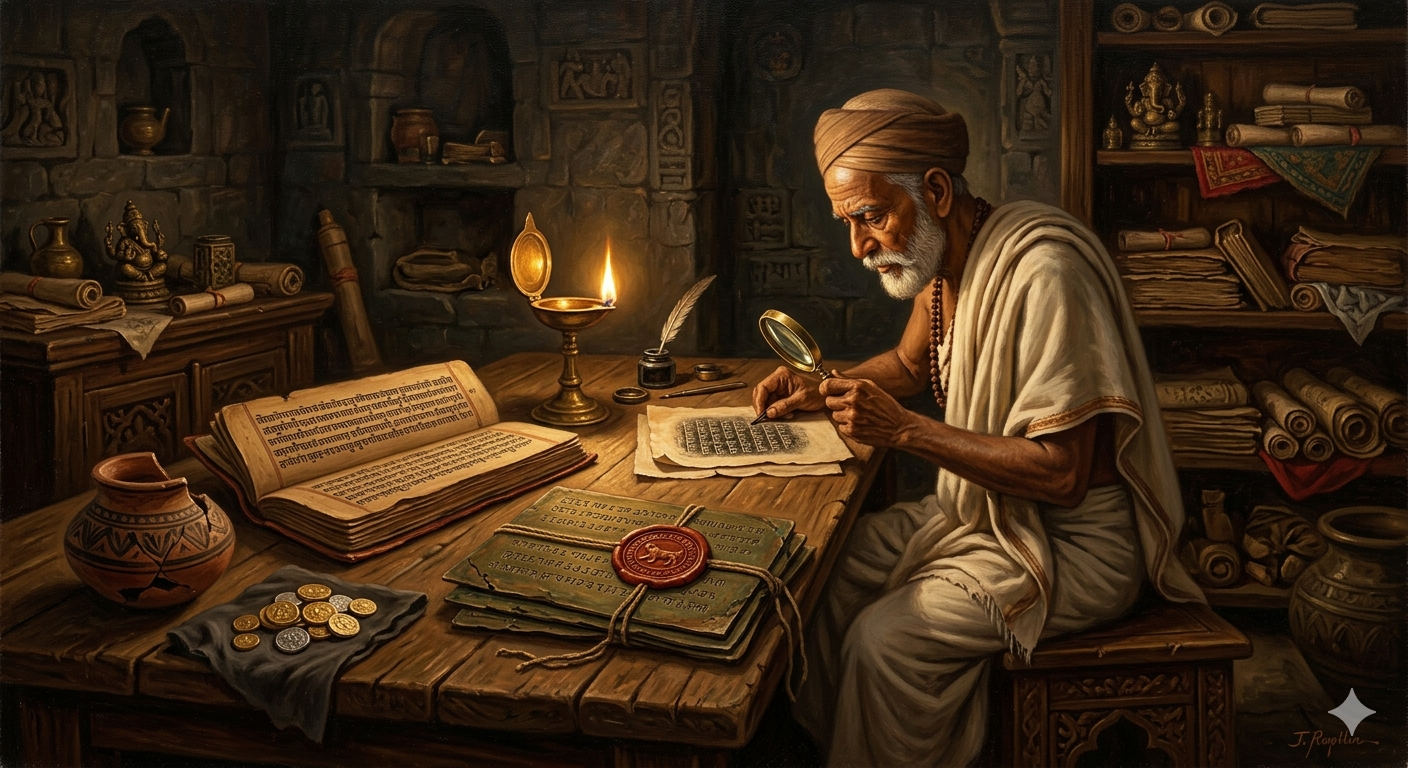
History is often described as a conversation between the present and the past. But how do we actually know what happened hundreds or thousands of years ago? Since we cannot travel back in time to witness events directly, historians must act like detectives, piecing together the story of our ancestors using the clues they left behind. These clues are what we call “historical sources.” Simply put, historical sources are the evidence or materials that provide information about human life in the past. Without these sources, history would merely be guesswork or imagination.
In this article, we will explore the different tools and materials used to reconstruct the rich, diverse history of Bharat. First, we will examine the physical and written evidence available to us, specifically categorizing them into Archaeological, Inscriptional, Literary, and Oral sources. Following that, we will learn how historians measure the reliability of this evidence by dividing it into Primary and Secondary sources.
Understanding these foundational concepts is highly significant. For students preparing for school or competitive exams, it is the very first step in mastering the discipline of history. For general readers, grasping how historical sources work reveals that the story of ancient India is not just a collection of myths, but a carefully reconstructed reality based on tangible proof.
Types of Historical Sources
To reconstruct the past accurately, historians rely on evidence. This evidence comes in many forms and acts as a window into the lives of people who lived centuries or even millennia ago. Broadly speaking, we can classify the materials historians use to write history into four main categories: Archaeological, Inscriptional, Literary, and Oral sources.
Each type of source offers a unique perspective. By combining them, historians can cross-check facts and build a complete and reliable picture of ancient societies. Let us look at each type of source in detail to understand what it is and how it helps us study the history of Bharat.
Archaeological Sources: The Physical Remains of the Past
What are Archaeological Sources?
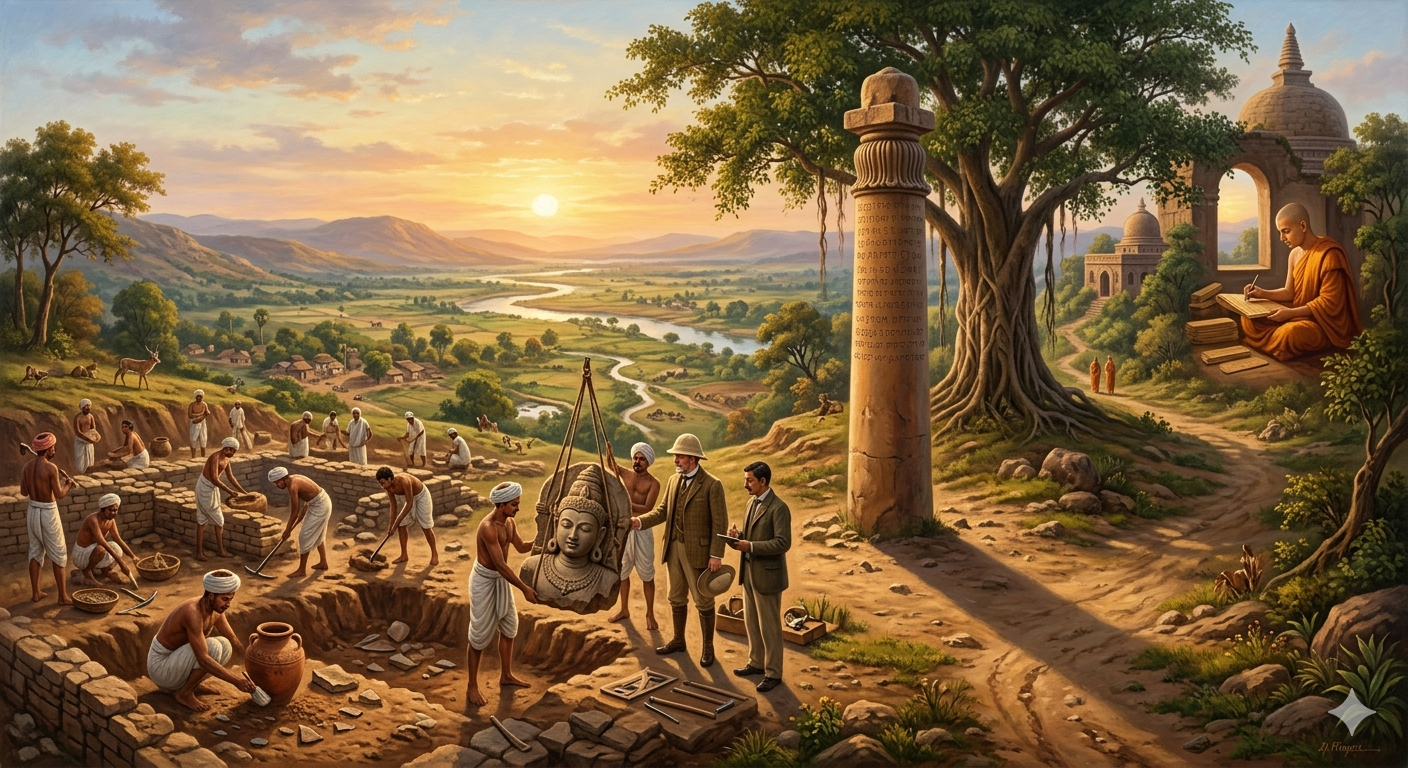
Archaeology is the scientific study of the past through material remains. Archaeological sources are the physical objects that people created, used, and left behind. These include monuments (like temples and forts), pottery, tools, weapons, jewelry, and coins. The study of coins specifically is known as Numismatics.
Why are they important?
Archaeological sources are especially crucial for understanding periods of history where no written records exist—a time we call prehistory. For example, everything we know about the ancient Indus Valley (Harappan) Civilization comes entirely from archaeological excavations, because historians have not yet been able to read their writing.
Furthermore, physical objects do not lie. While a written text might exaggerate the greatness of a king, a buried city or a rusted sword gives us hard, unbiased facts about the technology, economy, and daily life of the common people. Coins, for instance, tell us about the economic wealth of a kingdom, the trading partners they had, and even the religious beliefs of the rulers whose faces or gods are stamped on them.
Inscriptional Sources (Epigraphy): Words Carved in Stone
What are Inscriptions?
Inscriptions are writings engraved on relatively hard and permanent surfaces, such as stone pillars, rock walls, cave walls, temple walls, and copper plates. The systematic study of these inscriptions is called Epigraphy.
Why are they important?
Inscriptions are considered one of the most reliable sources of history. Because they are carved into hard materials, they are very difficult to alter or tamper with after they are created. This means an inscription usually reaches us in the exact form it was written thousands of years ago.
They provide precise information about specific events. For example, Emperor Ashoka placed massive stone pillars across his empire. The edicts (orders or messages) carved onto these pillars tell us directly about his administrative policies and his philosophy of Dhamma (righteousness). Similarly, in ancient and medieval India, kings frequently recorded land grants given to priests or temples on copper plates. These copper plates serve as legal documents that help historians understand the economic system, land ownership, and local administration of that time.
Literary Sources: The Written Records
What are Literary Sources?
Literary sources include all written texts from the past. In ancient times, before the invention of paper, people in the Indian subcontinent wrote on materials like palm leaves, birch bark (bhurjapatra), and animal skins. These handwritten texts are called manuscripts.
To make them easier to study, historians divide literary sources into two main groups:
- Indigenous Literature: Texts written by native people. This is further divided into Religious literature (like the Vedas, the Upanishads, the Ramayana, and the Mahabharata, which tell us about beliefs, rituals, and social structures) and Secular literature (non-religious texts like Kautilya’s Arthashastra, which is a practical manual on statecraft and economy).
- Foreign Accounts: Writings by travelers, pilgrims, and ambassadors who visited India. For instance, Megasthenes, a Greek ambassador, wrote the Indica, which describes the Mauryan capital. Later, Chinese Buddhist pilgrims like Xuanzang left detailed travelogues about Indian society and education.
Challenges of Literary Sources
While written records are incredibly detailed, historians must use them cautiously. Texts often contain the personal biases of the author. A court poet, for example, might exaggerate a king’s victories to please him. Therefore, historians must always ask: Who wrote this? For whom was it written? And what was the author’s motive?
Oral Sources: The Voice of Tradition
What are Oral Sources?
Not all history is written down or built into monuments. Oral sources refer to the historical knowledge, traditions, and memories passed down from generation to generation by word of mouth. This includes folk songs, myths, legends, proverbs, and epic poems told by traditional storytellers.
Why are they important?
For a long time, academic history focused mostly on written texts. However, written history was usually created by the elite—kings, priests, and scholars. Oral history is vital because it captures the voices, struggles, and beliefs of ordinary people, tribal communities, and marginalized groups who may not have had access to written language.
Challenges of Oral Sources
The main difficulty with oral sources is that human memory is not perfect. As stories are told and retold over hundreds of years, details can change, and myths can blend with actual historical events. Therefore, historians must carefully cross-check oral traditions against archaeological or literary evidence to separate historical fact from legend.
Classification by Reliability: Primary and Secondary Sources
In the previous section, we explored the physical forms that historical evidence can take, ranging from buried artifacts to written manuscripts. However, discovering a source is only the first step. A historian must also evaluate how trustworthy that evidence is. To determine the reliability and distance of a source from an actual event, historians classify all historical evidence into two fundamental categories: Primary Sources and Secondary Sources.
Understanding the distinction between these two concepts is essential for anyone learning how history is written and analyzed.
Primary Sources: The Direct Witnesses
What is a Primary Source?
A primary source is firsthand, original evidence. It is an object, document, or testimony created during the specific time period being studied, or shortly afterward by someone who directly participated in or witnessed the events. You can think of primary sources as the raw, unfiltered materials of history.
Examples of Primary Sources
Almost all the physical evidence we discussed earlier falls into this category. The Ashokan rock edicts, Harappan seals, and ancient Chola copper plates are all primary sources because they were created by the people living in those exact eras. Similarly, Megasthenes’ Indica or the original palm-leaf manuscripts of the Arthashastra are primary literary sources.
Why are they important, and how are they used?
Primary sources are the bedrock of historical research because they offer a direct, unmediated window into the past. Without them, history would just be guesswork. However, historians cannot blindly trust them. A primary source only captures one specific point of view. For instance, a royal inscription claiming a king never lost a battle might be political propaganda rather than absolute truth. Therefore, the historian’s job is to cross-examine multiple primary sources to identify biases, motives, and missing perspectives.
Secondary Sources: The Scholar’s Interpretation
What is a Secondary Source?
A secondary source is an account or interpretation of the past created after the events have occurred, by individuals who did not personally witness them. Instead of experiencing the history firsthand, the authors of secondary sources study, analyze, and synthesize primary sources to draw conclusions. If primary sources are the raw bricks and mortar, secondary sources are the completed buildings constructed by historians.
Examples of Secondary Sources
The history textbook you read in school is a classic example of a secondary source. If a modern historian spends ten years translating ancient inscriptions and digging up coins to write a new book about the Gupta Empire, that newly published book is a secondary source. Documentaries, encyclopedias, and academic journal articles also fall into this category.
Why are they important, and how are they used?
You might wonder why we need secondary sources if primary sources give us the direct facts. The reality is that primary sources are often fragmented, difficult to interpret, or written in ancient, dead languages. Secondary sources are vital because they process this raw data into an understandable narrative. Furthermore, secondary sources benefit from hindsight. A modern historian writing a secondary source can see the long-term consequences of an ancient war—something the soldiers who fought in it (the primary witnesses) could never have known.
The Connection Between Primary and Secondary Sources
In the study of Indian history, these two types of sources do not work in isolation; they depend on each other. A rigorous historian uses primary sources as the factual foundation of their research. They then consult existing secondary sources to understand how other scholars have interpreted those same facts. By blending the raw authenticity of primary evidence with the structured analysis of secondary literature, historians can reconstruct the history of Bharat with both accuracy and deep understanding.
Conclusion
To study history is to study the evidence. As we have discussed, the long and complex history of Bharat is not drawn from a single book, but reconstructed using a rich variety of sources, each acting as a unique piece of a massive puzzle. Archaeological findings and epigraphic inscriptions provide us with hard, physical facts about ancient societies, while literary texts and oral traditions offer deep insights into the thoughts, beliefs, and daily lives of the people. Furthermore, by classifying these materials into primary sources (the direct, raw evidence) and secondary sources (the scholar’s later analysis), historians are able to systematically test the reliability of their information.
The most crucial takeaway for any student of history is that no single source is perfect or complete. A written text might contain the author’s political bias, and an archaeological artifact lacks a voice to explain its exact purpose. Therefore, a historian must constantly cross-check different types of evidence against one another to build a balanced and accurate narrative.
Ultimately, understanding the sources of Indian history teaches us how the past is actually written. It allows us to move beyond simply memorizing dates and events, empowering us to evaluate historical claims critically and appreciate the rigorous, scientific process that brings the ancient history of Bharat to life.
FAQs (Frequently Asked Questions)
Sources & References
- Upinder Singh – A History of Ancient and Early Medieval India: From the Stone Age to the 12th Century
- R.S. Sharma – India’s Ancient Past
- Romila Thapar – Early India: From the Origins to AD 1300
- A.L. Basham – The Wonder That Was India
- E. Sreedharan – A Textbook of Historiography
- Kautilya – Arthashastra
- The Edicts of Ashoka